Showing posts with label Bars and Breweries. Show all posts

Monday, September 13, 2010

Beer of the Week


Over the past six months I have found a love of sour and wild beers. A stand out amongst crowd has been Flat Earth’s Extra Medium. Flat Earth, a St. Paul brewery which has been featured by us before, has done it again with this sour cherry beer.

I first got to try this tasty brew at the Muddy Pig and it has had a place on their taps as well as my heart for the past few months. Muddy Pig has become a frequent hang out for Ryan and I since our move to St. Paul and bringing great beers like Extra Medium is why. This is the description from Flat Earth's website:

This American wild ale was brewed using a blended strain of yeast that created this unique and refreshing beer. Brewed in the summer and allowed to age in an unjacketed tank for a year to fully develop its flavors. Extra Medium has an aroma of tart cherries, lemon and a slight inner city funk. It is refreshingly tart and sour with hints of orange marmalade, whiskey and citrus rind. Extra medium pairs well with salads, pungent cheeses and angel food cake.

The first thing that grabs you is the rich red color of this cloudy beer. The smell is an intoxicating blend of pungent yeast with notes of cherry, cranberry and apple cider vinegar. The carbonation is light which I prefer in sours. The taste is full a bodied sour cherry, with a yeasty vinegar and lemon notes. The sour taste is there but blends nicely with some malty sweetness.

This is an everyman’s kind of sour as opposed to some of the stronger tasting varieties. Wild but still palatable. If you haven’t been able to get into sours or wild beers I strongly suggest this one to help you appreciate the style.

Links of Interest:


Digg this

Tuesday, July 15, 2008

Bars on the Brain - Pt. II

Part II in our bars special is located in Minnesota:

The Muddy Pig
162 Dale St. N
St. Paul, MN

In an area only twenty years ago home to dangerous vices like hard drugs and illicit gambling, the Selby-Dale neighborhood of Saint Paul has now begun to embrace simpler vices: coffee and beer for example.

The neighborhood's transformation from slum to one of Saint Paul's more desirable neighborhoods is nearly complete with all the hallmarks of gentrification: coffee shops; a co-op; a new pizza joint; and its own neighborhood bistro, the Muddy Pig.

I think that bistro might be too lofty of a term for the Pig; I would describe more as a "beer bar." While the Pig does have an extensive selection of foods, it's the extensive selection of beers that will keep you coming back.

The Pig has rotating tappers pouring local favorites such as Rush River and Summit, domestic winners like Bell's and Left Hand, and Belgian delights like Delerium and Rodenbach Grand Cru.

Besides the tappers, the Pig has a decent selection of mostly Belgian bottles. There are the stand-bys like Chimay and Corsendonk, as well as some rare bits like De Ranke XX Bitter and Cuvee Angelique.

If I lived in the Selby-Dale area, I certainly would frequent the Muddy Pig; however, living across town, I would be more tempted to venture there if the food kept pace with the beer selection. Should you find yourself in Saint Paul it would certainly be wise to stop in and see what delicious taps the Pig has rotated in.

Links of Interest:

The Muddy Pig

Digg this

Monday, July 14, 2008

Bars on the Brain

It's been a while since I've graced the pages of the interwebs with some fresh beer material; what can I say, it's summer and I'm busier drinking beer than writing about it.

But, I do feel a slight obligation to the readers, so I'll provide two beer-bar reviews over the next two days; here's the first.

The Palm Tavern
2989 S. Kinnickinnic Ave
Milwaukee, WI

The Palm occupies a very unassuming facade on Kinninckinnic Avenue (known in local parlance as "K-K") in the vibrant Milwaukee neighborhood of Bay View. While on the exterior the Palm looks very much like any other dive bar that slings south-side sauce, the interior and vibe are distinctly different.

Wisconsin's capital city, Madison, has banned smoking in bars for a few years now, but Milwaukeeans are still free to light up at will...but not at the Palm. The establishment is smoke free; there are no ash trays on the tables, and consequently, you won't smell like one when you leave.

Upon entering the Palm, the bartender may hand you a menu that has nothing to do with food. Instead, the menu details the impressively extensive selection of taps, bottles, and big Belgian styled bottles, and an equally impressive collection of scotch whiskey, if that's your thing.

The draft menu is limited, but qaulity. Featuring selections from La Chouffe, Bell's, Left Hand, and Anchor, the taps are a good place to start. The bottle selection, going on for pages, is where to look for something exotic, or to find your old micro-stand by.

The Palm Tavern is certainly unique for a South Side pub, and is a welcome staple on K-K. If the Palm isn't your scene and you'd prefer a PBR and a cigarette, you can try the less classy, but definitely fun "Lee's Luxury Lounge;" it's right across the street.


Links of Interest:

The Palm Tavern

Digg this

Monday, May 19, 2008

Don't Worry, Be Grumpy

Some of you out there in beerland are so into your hobby that you plan side-trips to brewpubs and breweries on your travels (or entire trips if you're die hard). In that spirit allow me to point out a charming destination in Mt. Horeb, Wisconsin.

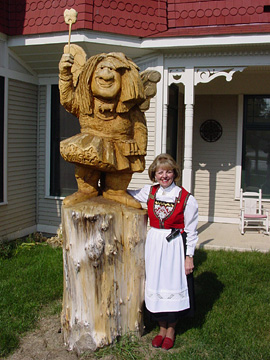
Mt. Horeb, affectionately known as the "Troll Capital of the World," a nod to the town's Norweigian heritage and Main Street which is lined with troll sculptures and nicknamed the "Trollway," is a classic Midwestern small town with a population of 5800. It lies about a 30 minute drive from the state capital, but is much further than that in terms of lifestyle.

The town's Main Street retains many original buildings, antique shops, a bakery, and most notably, the Mustard Museum.


Most beer lovers out there also carry an affinity for fine mustard, and as such, this is a required stop. The Mustard Museum features mustards displayed from around the world, and offers an equal sized gift shop where one can taste hundreds of mustards and of course purchase.

Right around the corner from the Mustard Museum is our featured attraction: The Grumpy Troll.

The Grumpy Troll was opened in 1996 in the former Mt. Horeb Creamery. The pub has 8 beers on tap including a wheat, an IPA, a Red Ale, and a Stout. The CCCP Stout and the Maggie IPA are the standouts in my opinion, but should you have trouble deciding, they sell a sampler featuring all 8 beers (plus a special brew if you're lukcy) in 4oz sample sizes.

The restaurant features a giant menu with plenty of dishes for the carnivore and vegitarian alike. The bratwurst is delicious and comes slathered in sauerkraut, accompanied, of course, by side of delicious mustard.

The Troll is a nice addition to the town's charming Main Street, and adds a destination for beer lovers and hungry townies and tourists. While the brewpub only has a few standouts, that's more than I can say for many brewpubs, and on the whole, it's well above average and worth visiting.

Digg this

Monday, February 25, 2008

Crockfest

This weekend I had the unfortunate displeasure of attending Capital Brewery's Bockfest, held on their grounds annually in Middleton, Wisconsin.

The event celebrates the special limited release of Capital's blonde bock, as well as their Maibock, which is supposed to herald the arriving of spring. It generally features a band, contests, and for some reason, fish that are thrown off the roof into the crowd below. In other words, it has all the makings of a good time: unfortunately, it wasn't.

Bockfest was a tragic victim of its own success. We arrived at 12:30, a mere half an hour after the taps opened, and the grounds were already well over what should have been its capacity. The "grounds" were essentially just a series of large lines; in fact, I would guess that 90% of the people actually at the event were waiting in a line.

Perhaps line is even too generous of a description; it was more "totally disorganized mob waiting for beer." There was absolutely no order to the lines, which made waiting in them, or even finding the end of them, extremely challenging.

Now, I don't mind waiting in lines for things; I've been known to frequent a crowded bar. But the prospect of getting beer in these particular lines was slim; they didn't seem to be moving, and stopping interlopers from accessing the mob at all points was impossible. We waited in line for 90 minutes before we gave up and left.

My primary gripe was of course the lack of access to beer. A secondary gripe was in the crowd that the event seemed to attract. This wasn't the beer lover class that I see at the Great Taste of the Midwest, or other beer related events; this was a weird mix of sorority girls, UW college drunks, and small town folks bussed from outlying bars who had bought ticket packages to get there and get beer. It felt more like Milwaukee's Summerfest on a Friday night than a beer celebration (full disclosure: I have NEVER had trouble getting beer at Summerfest, no matter how crowded it gets; I'm definitely not slamming the 'fest).

All this for the privilege to pay bar prices for beer!

I'm not sure how Capital can save this event, but it definitely needs to be saved from itself. My advice would be to sell pre-sale tickets. I think this would have the effect of limiting attendance, while guaranteeing admission to those who are genuinely interested. If Capital wanted to keep costs for attendees down en lieu of the door price, they could lower beer prices slightly. I'm sure that although the attendance would be lower, the brewery could clear as much revenue by actually selling more beers to fewer people.

As it stands, I would advise anyone to avoid Bockfest until Capital can save it from itself.

Digg this

Tuesday, February 5, 2008

Beer is proof God loves us...

And so is the sun. The sun allows us to grow barely and hops, heats our planet, and makes life possible. Solar energy is the oldest form of energy on our fine earth, and for at least the next 4 billion years, it is also renewable.

Other than basic horticulture, what does this have to with beer?

Well a brewery in beer and hippie friendly Oregon has gone and combined two of my passions into one operation: brewing, and renewable energy.

The Lucky Lab Brewery of Portland uses a solar thermal system to heat up the water, which for brewing must get up to 160 degrees. I was wondering how this system could allow for the brewing of beer in winter, but according to the Lucky Lab's website they were able to get the water to 145 just last week, and the system is also supplemented with traditional heat.

I have to say that I was impressed by the 145 degree achievement in the grey Portland winter, and I'm sure that the system will have absolutely no trouble come summer. Given the vast amounts of hot water needed to run a brewery, the Lab is truly that: an experiment in environmental efficiency for small scale brewers. After a few years of operation, the Lucky Lab will be able to provide a real world example of carbon free heating, and give other brewers a cost/reward example as well.

I've never been to the Lucky Lab, but I can guarantee that I will make it a point to go the moment I set foot in Portland. I applaud their efforts from a brewing and environmental standpoint, and wish them nothing but hot water and cold brews.

If you live in Portland, or know someone who does, tell them about the Lucky Labrador.

Digg this

Wednesday, January 30, 2008

Lakefront Brewery - The Tour

I love touring a brewery; it really puts you in touch with the family and community aspect that most craft brewers seem to cultivate.

Milwaukee's Lakefront Brewery has all the elements that I would want to experience in a good brewery tour: it's in a nice old "brewery like" building; the employees are nice and definitely seem to love their jobs; the tour is easily accessible; and of course, there is a large amount of fresh beer to be had.

Although the brewery is in a "great place on a Great Lake," Lakefront's facility is not actually on a lakefront, but rather, near downtown Milwaukee on the Milwaukee River. The building is an old brick warehouse, surrounded on the street by a hill, an old rusty train bridge, and the "renewal" of Milwaukee's downtown, condos.

You enter through two large wooden doors and pay the very reasonable $5 fee and are then presented with some very cool wooden nickels which entitle you to free samples from the bar. The bar is in a very large room that is artificially divided in the center and filled with tables. The room doubles as a banquet hall where people hold weddings and other events, and has a nice old Milwaukee aesthetic, albeit sparse.

After you have quaffed a few of Lakefront's offerings, you head downstairs into the brewery itself. The passageways inside the brewery are narrow, so make sure you get to the front of the pack if you want to hear what is going on.

Besides walking past fresh bags of malted barley and giant vats, there is some visual candy of the unexpected sort, especially for baseball fans. Lakefront acquired some relics from Milwaukee's County Stadium and preserved them inside the brewery, a proper place to house relics of the Brewers if you ask me.

The Brewers mascot is a happy fellow who looks like a Swiss/German immigrant and is named "Bernie Brewer." Bernie used to reside in a chalet fitting to his teutonic appearance, and slide into a giant frothy mug of beer upon home team homers, but alas the chalet went the way of the "two-fisted slobber" when County Stadium was torn down. In the Brewer's new home of Miller park, Bernie does not have a chalet, nor does he slide into a large beer mug, which is all the more sad considering the namesake of the stadium.

I thought that I would never again be able to experience this glorious icon of my childhood and of Milwaukee's history, but the good people at Lakefront have preserved it for us. Within the brewery are not only the entire chalet, but also the beer mug, as well as the front of a giant faux-keg with "Go Brewers" on it. Ladies and gentlemen, let me assure you that I have been to the frozen tundra of Lambeau Field in Titletown, and actually standing in the chalet (that's right, it's open to the public) was an equally great sports moment in my life.

After the completion of a talk on the brewing process, an "in brewery" sample, and a discussion of kegging, including jokes about the bung and the bung hole, we were in for a real Milwaukee treat: we got to sing the Laverne & Shirley theme song while a bottle with a glove on it spun by. I must say to the beer lover and native Milwaukeean, it was epic.

After this you head back upstairs for some more sampling as well as nice surprise: a free glass pint with a proper Lakefront Brewery logo on it. All this for five dollars.

The information side of the tour is not lacking; however, it's not really overwhelming either. The spoken part of the tour is not the main reason to go here though: it's the total experience. This is an old warehouse, in brew city, with old baseball lore and TV sitcom kitsch built in! It really doesn't get a whole lot better than that. Try the "East Side Dark" and the "Riverwest Stein" while you are there: two beers that are named for two classic and dynamic Milwaukee neighborhoods, and have classic and dynamic tastes to match.

Thank you so much to the people at Lakefront Brewery for making this a totally unforgettable experience for Amber and me. Cheers!

Links of Interest:

Lakefront Brewery Tour

Digg this

Monday, November 19, 2007

Water Street Brewery


Established in downtown Milwaukee in 1987, Water Street Brewery (WSB) was certainly at the vanguard of the brewpub movement. Housed in a turn-of-the-century brick building with large brew kettles visable behind glass walls, the brewpub exudes Milwaukee charm.

Water Street initially offered just three varieties of beer, but now WSB has a full slate, including a pale ale, a weiss, an amber ale, an Oktoberfest, a "Munich" lager, and a large rotation of seasonals, this time featuring a "Black Lager."

The Weiss did not stock up in calibre to some of the great Germans like Hacker-Pschorr or Franziskaner, but it was well made and delicious. To put it on more equal footing, I prefer it to the Great Dane Crop Circle Wheat (a brewpub in Madison).

The Black Lager, however, was delicious. Although it does use some malts that have been roasted longer, it's much more a black pilsner than a stout. It's light but definitely has texture, with a clean malty taste reminiscent of a St. Pauli Girl Dark. Definitely reccommended.

The menu is extremely extensive for a brewpub and offers the full gamet of fare: from appetizers, to salads, to sandwiches, to chef specialties. The current brewmaster is George Bluvas III, but I confess I'm also interested in who the executive chef is. There were classic Milwaukee sausage options, with wares from nearby Usinger's, as well as light fare with a Yellowfin sandwich, salads, and vegitarian options.

Located near Milwaukee's Performing Arts Center (PAC), the Pabst Theatre, and the Bradley Center (home of the Milwaukee Bucks and Marquette Golden Eagles), the WSB is ideally situtated for you to try it's food and more importantly, it's beer. Visit this Milwaukee staple the next time you are in town.


Links of Interest:
Water Street Brewery

Digg this

Monday, November 12, 2007

The Corporate "Brewpub"


I suppose it was only a matter of time: realize that America thought brewpubs were quaint, unique, and a part of the community, and suck the soul out of it for packaging and mass consumption.

Amber & I went to the Granite City brewery this weekend in Madison. Perhaps I should say a Granite City versus the Granite City because there are similar structures in Minnesota, the Dakotas, Nebraska, Kansas, Arkansas, Illinois, Indiana, Missouri, Iowa, and Ohio. In fact this NASDAQ listed (GCFB) publicly traded company has ballooned from 1 location to 20 locations in just 8 years. In fact, their second "brewpub" opened for business less than 18 months after their first. To me that says "business plan" more than "brewery." The experience at Granite City reflects that.

The exterior of Granite City (which was in a mall parking lot) looked like a prefab sprawl-pod that just as easily could have hung up a "Tumbleweed" or "Applebee's" sign. The interior was drab and boring. This place didn't reek of brewing lore; it was closer to TGI Friday's, 10 years superficially matured.

The menu was extensive, extremely extensive, which made the following omission that much more glaring: the lack of vegetarian options. Now, I'm no vegetarian, but I do like to limit my meat intake, and there were no options for that. What if I wanted to go there with my veggie friends? Are they to have a house salad and nothing more?

The service was OK, although I felt like I was dealing with Chili's rejects. What was with all the buddy-buddy chat, and the upselling? I'm not afraid to order an appetizer, I just don't want one. Also, he knew nothing about beer, which in a brewpub is kind of a "no-no."

To the important stuff: I hate to say it, but their IPA and bock weren't bad, if unadventurous. The IPA was a clear copper with a minimal floral head, and a nice sufficient hopped finish. At 5.2%, it could stand a little more alcohol, but it was definitely drinkable. The Bock was slightly better than the IPA, but also not outstanding. It was smooth and moderately malty with an almost non-existent head. It was slightly sweet, but not overpowering. Drinkable, but middle of the road and vanilla, especially for a Mai Bock. We also sampled the "Northern Light," which was a light lager, that tasted like a Miller Lite. I was afraid it would be watery, but it wasn't; there was a little American lager flavor shining through, although there was scant carbonation and no head. To tell you the truth, you'd be better off ordering a Miller Lite.

When I first heard about Granite City, I was thinking that it was a new upstart brewery from the Minnesota city from which it takes its name (St. Cloud). But this brewpub was an idea cooked up in a board room, not a brewpot. There is obviously a lot of financing behind this chain, and you can be sure that if you live in Suburbia, Granite City is scouting mall parking lots near you. If during the holiday season, you find yourself out in the sprawl doing some shopping, I would suggest checking it out for yourself; it's a nice respite from the Olive Garden. Otherwise, don't go out of your way.

Links of Interest:
Granite City

Digg this

Thursday, November 1, 2007

Pale Ale, Pt. III

Two days ago we started our exploration of the genesis and development of the pale ale world, which included the development of the India Pale Ale (IPA). We followed that up yesterday with an IPA recommendation, a Burton brewers overview, and an introduction to English Bitter. Today we continue on our IPA-like voyage to unravel the term pale ale, talking more about bitters, and the American pale ale (APA).

As I mentioned yesterday, bitters are less common stateside, and are sometimes found masquerading as a plain "ale" or simply as an "ESB;" however, bitters, both in name and style can be found.

Nestled between downtown Minneapolis and the University of Minnesota is Town Hall Brewery. Town Hall is a bar-lovers bar. It has lots of dark wood, a proper food selection, beer specials, a huge scotch selection, pool by the hour, and a great patio. Additionally they have a few good brews. The West Bank Pub Ale is so named for a section of the city on the west side of the Mississippi River, and it used to go by the name West Bank Bitter. While it is perhaps more hoppy than other "mild" ales, it has a nice malt balance. It has an alcohol content of 4.6% (which might fall into the "best" category of bitters in the UK) and is what Town Hall calls their "session beer" (you can have a few and not get totally munted). The beer has smooth medium bodied mouthfeel, and is a rich copper hue. If you're in Minneapolis, swing by Town Hall for an American example of an English bitter, and try the award winning Oatmeal Stout while you're there.

So where does the APA fit into this?

Knowing the brashness and ingenuity of Americans, it should come as no surprise that American brewers would not be content to simply adopt the brewing traditions of the old countries...not without a few tweaks that is. Early Dutch and English brewers brought over their traditions of ales and porters, but later, Central European immigrants did the same. Brewing innovation in the mid-19th century brought the pale lager and pilsner to the fore, and the popularity of this beer spread from Germany and Bohemia all over Europe and to the United States. These pale lagers began to dominate the US market and could be produced easily using indigenous grain like corn. Towards the end of the 20th century, the early traditions of American ales had all but vanished. Simultaneously, consolidation and taxation were doing a number on the other side of the pond, and British ale crafters were disappearing or producing low alcohol bitters. The ale traditions of early America were in serious jeopardy: enter the California ale revolution.

The San Francisco based Liberty Ale mentioned in yesterday's column was Anchor Brewery's attempt at a real ale. First produced in 1975, it emerged as one of the first (if not the first) known examples of a commercially successful ale produced in the US in quite some time. Just a few years later in 1980, a brewery in Chico, California produced what would become what many consider the prototype of the APA, Sierra Nevada Pale Ale.

Sierra Nevada Pale Ale has a truly American flare, using Cascade hops, giving the brew a dry, floral character, without the carmelly malt back of a British pale ale. This unabashed "in-your-face" hop flavor is a characteristic of the APA, which is drawn in part from using native hops. Sierra's is in the middle of the color range for what you might find in an APA, and has been a huge commercial success. Sierra Nevada has since expanded their brewing facilities and produces many other quality brews including an IPA and a Porter. Breweries like Anchor and Sierra Nevada helped prompt the huge agricultural boom of hops in the Willamette and Yakima valleys, further expanding the possibilities for unique American ales.

APAs are almost synonymous with the craft brewing explosion of the last twenty years, so go to your local beer depot and find a local example. For a Midwestern example, try the Great Lakes Burning River Pale Ale, made in Cleveland. It's not my favorite, as many of the West Coast breweries do it better, but it's worth a try.

Links of Interest:
Sierra Nevada Pale Ale
Great Lakes' Burning River

Digg this

Thursday, October 25, 2007

Brasserie V

Amber and I stumbled across a very nice suprise while shopping for Halloween wear yesterday: a new restaurant and "tap room" on Monroe Street in Madison called Brasserie V. A Brasserie is a fancy word for a place that is a beer bar, that also usually serves hearty, simple or cheap food. While Brasserie V certainly lives up to the first part of the definition, its food is not what I would call simple, nor is it cheap, but it is fantastic.

Let me start first with the main part of this definition, and the main reason that you should visit V (or this blog): beer. V has an amazing selection of taps, if a bit heavy on the Belgian side (not a bad thing), including many brews rarely seen on taps this side of the Atlantic.

The selection is worth listing in its entirety: Abbaye des Rocs Triple Imperiale (10% ABV, Belgium), Ale Asylum Diablo (8.5% Wisconsin), Anchor Porter (5.6% California), Brugse Zot (6% Belgium), Capital Autumnal Fire (8.5% Wisconsin), Chimay Triple (8% Belgium), Corsendonk Pater (7.5% Belgium), Duchesse De Bourgone (5% Belgium), Erdinger Weiss Dunkel (5.6% Germany), La Trappe Quadrupel (10% The Netherlands), Murphy's Stout (4% Ireland), St Bernardus ABT 12 (10% Belgium), St Bernardus Tripel (8% Belgium), Unibroue Chambly Noire (6% Canada). I won't even go into their extensive bottle selection that includes gems like Konigshoeven Dubbel, Westmalle Triple, Dogfishhead Pumpkin Ale, NC Brother Thelonius, and Ayinger Weiss.

The brews are served in appropriate glasses, sometimes matching the brewery from which they came. They also have beers on special for you bargain hunters out there, and wine for those of you that should probably be reading a different blog.

The food had a French meets American Posh feel, with a diverse selection of sandwiches, salads, and entrees that can cater to most palettes, from Pomme Frites and Cheese Plates, to a portabello sandwich and BBQ pork with red cabbage. I had the Wisconsin Rainbow Trout, which was cooked to perfection and stuffed with a garlic and leek mixture that made the fish melt in your mouth. Amber chose the Prince Edward Island mussels, which were served in a white wine, butter and garlic broth. The mussels were a fine quality, not rubbery, and were much complemented by the broth.

Between the amazing beer selection, excellent food, and attentive service, we think we may have found a new favorite in Madison. If you live here, go, and if you don't, make a point of visiting when you are here.

Links of Interest:
Brasserie V

Digg this