 There's something about a pale, yet flavorful ale, heavy on the hops, that is the perfect crisp smack off the lips on a summer evening. Stone IPA fits the bill, and is our BOTW.
Founded in 1996, the Econdido, CA based brewery has grown from 400 barrels to 98,500 barrels in just 13 short years. Stone's IPA was released shortly after the brewery opened, in 1997.
The beer is a rich golden color, perhaps a little lighter than some other IPAs. The nose is all hops: a mix of Columbus, Chinook, and Centennial. You can really tell this brew was dry-hopped.
The taste reflects the smell: strong hop flavor, as well as bitterness. There is just enough biscuit and grain tasting malts to balance this one out. The beer finishes clean and crisp, leaving a little hop flavor and fruitiness on the tongue.
This is an IPA's IPA: big, bold, and bitter. If you're just getting into hoppy beers, you might want to try a few others first. Not only is this a West Coast hop bomb in terms of aroma and bitterness, it also tops out at 6.9% ABV. Not for the faint of heart.
That said, it truly is a clean and crisp beer. Perfect for patio sipping and savoring on a warm summer evening.
Friday, June 25, 2010
Beer of the Week


Tuesday, June 22, 2010
Pack It In
It's summer in the upper-Midwest, and for those of you like me, you want to seize this precious 6 weeks and cram in as much outdoors time as possible.
When it comes to "drive-in" camping, one doesn't have to put much thought into what beer to bring: if it fits in the cooler, it works. When it comes to day-hikes, backpacking, or boating, however, one has to plan a little better.
With hiking, beyond the obvious concern of weight going in (glass is heavier than cans), you have to consider the weight coming out. With hiking or boating, you certainly don't want to leave your trash behind (or toss it in the lake), so whatever you "pack in" you'll have to "pack out." This again, suggests that canned beers are the preferable hiking beers. Finally, bottles break. You don't want broken glass in your pack or in your boat. Bottom line: start looking for cans.
Unfortunately, many, if not most craft beers fail to offer their wares in cans. Fortunately, there are some craft offerings that are both delicious and canned.
BEER ON THE BRAIN'S 2010 HIKING/BOATING BEER GUIDE:
1. Dale's Pale Ale - Oskar Blues (Colorado)
Oskar Blues was the pioneer in canning craft beer. Since 2002, Dale's Pale Ale, Oskar's signature ale, has been offered only in cans.
This American Pale Ale has a nice citrus/grapefruit hops nose and a slightly sweet bready malt body. It's bitter, with a clean hop finish that's perfect on a hot sunny day. Lots of flavor, but not too heavy.
2. Surly Cynic - Surly Brewing (Minnesota)
Surly is a staunch advocate of canned beer, choosing to release their entire line of award-winning craft brews in cans.
The Cynic is a Saison/Farmhouse style ale and pours a rich vibrant gold. You can smell some Belgian-style yeast notes as well as some coriander and spice. The beer has a medium body, smooth, with the perfect level of carbonation. Being Surly, there are a bit more hops in this one then you'll find in others of the same style. Great for a hot day. If you can find a better Saison in a can, well, if can find another Saison in a can, you'll be lucky.
3. Brew Free or Die IPA - 21st Amendment Brewery (California)
Although founded in 2000, 21st Amendment has only recently found its way out the Midwest. We're happy it made it out here. With a six hop punch in the nose, and a nice balanced malt back, their IPA is another solid offering from the Left Coast. Bonus for us flyover-land hikers and boaters? It comes in a can and is generally cheaper than the aforementioned beers.
Honorable Mentions:
Fat Tire - New Belgium Brewing (Colorado)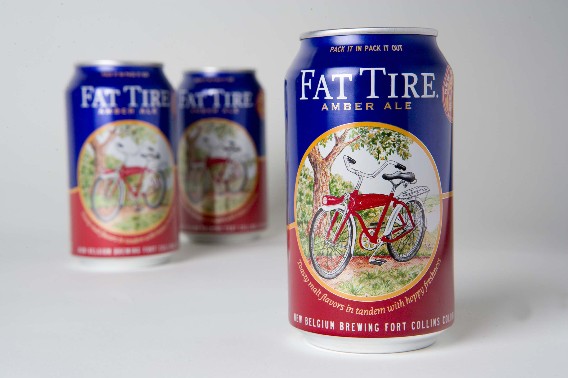
New Belgium's flagship is also available in a can. Surprisingly, should you take the time to pour one out, it tastes better out of the can, then out of the bottle! This is no coincidence. As Bon Appetit puts it, "New Belgium adds a slurry of active live yeast to its Fat Tire cans just before sealing to take up oxygen and prevent stale off-flavors. The result is a fresher, more complex beer. Think of it as a mini keg."
Hamm's Lager - Hamm's (Wisconsin)
It might be owned my MillerCoors now, but those of us in the "Land of Sky Blue Waters" still know that a Hamm's tastes great out on the canoe. Lest you think I'm succumbing to nostalgia and clever marketing, Hamm's won the gold for best American Lager at the Great American Beer Festival in 2007.
Friday, August 7, 2009
Beer of the Week
 Lagunitas (lah-goo-nee-tahs) is a can't miss brewery for those of you into that hopped up, west coast style. Their IPA is a standard setter (especially if you like those citrus, grapefruit IPAs), and their Lil' Sumpin' ale is outstanding.
Located in beautiful Petaluma, California, Lagunitas is located in the Beer Mecca of the US, the Pacific Northwest (sorry Colorado). Similar to other breweries in the area, Lagunitas is known for flavorful ales heavy on the hops.
The Imperial Red (now available in sixers!) is different in that it features the malts more than any other Lagunitas beer I've had. The malts are smooth, caramel, and along with the alcohol, give this beer a huge mouth feel. Despite the relatively "big" presence of this beer on the palette, the smoothness makes it sessionable. Note: at 9.6% ABV, don't "session" too many of these in one sitting.
There are hops present, and they have that signature Lagunitas nose about them: grapefruit and a general citrus. Unlike the brewery's "Maximus" or "Hop Stoopid," however, the hops aren't the feature, but equally, the aren't to be overlooked. This isn't a malt bomb, this is a well balanced ale.
Links of Interest:
Lagunitas Brewing Company
Friday, December 14, 2007
Beer of the Week

Well we're in the thick of the season now; there's no chance of avoiding it, so might as well throw up your hands and declare it a celebration. Better yet, fill up your mug and call it a celebration!
This BOTW comes to us from one of the patriarch breweries of the American craft beer revolution: Sierra Nevada of Chico, California. Their seasonal ale looks like the Sierra Pale Ale, except with a festive red and white label, and is named Celebration Ale.
It's not really the malty heartiness you get from a lot of winter warmers, nor is it the spiced weirdness you get from other seasonals. Celebration is more like a special IPA. It pours a rich amber color with a minimal head. Like Sierra's Pale Ale, it has a flowery, grapefruit smell, and a bitter hoppy flavor as well. It has a bit of malt balance, but the strong alcohol (6.8%) and the hops whisk away the sweetness for a dry crisp finish. I actually wish they would let the malts come through a little bit more, as they seem prematurely quashed by the hops. You might avoid serving this one too cold so a more balanced flavor can come through.
While to me, this isn't that much of a departure from their IPA and APA, it is a good beer with Sierra's signature style. Celebration is a pleasant diversion from malty and spiced winter beers, so scoop up a 12 pack, deck the halls, and declare it a celebration!
Links of Interest:
Sierra Nevada Celebration Ale
Monday, December 3, 2007
Beer of the Weekend

It was a good weekend to stay in here in the Midwest. After having to drink my sorrows away after the Packers lost to the Evil Empire (the Cowboys), and the bilzzard that hit Minnesota, Wisconsin, and Michigan, I needed some time to relax in the house.
Our BOTWE was definitely good for the described scenario; we chose Brother Thelonius belgian style dubbel from North Coast Brewing in California.
Brother Thelonius, so named for the legendary jazz musician, definitely comes in on the "big & sweet" side of Belgian brewing, with 9.2% ABV, and abundant sweet malts. It pours a dark reddish-brown color with a minimal head and minimal lacing. It has a dried fruit aroma typical of this style: a very nice nose actually. The mouthfeel is thick, but not as thick as some actual Belgians and has an alcoholic dry finish. It does lack some of the creaminess of the greats in this style, but it is damn good overall.
Congratulations to North Coast Brewing; Brother Thelonius is good company on a cold winter day.
Links of Interest:
North Coast Brewing
Wednesday, November 28, 2007
Green Beer
 No, we're not talking the dyed Miller Lite that the Holister crowd downs at the "urban" sports bar on St. Patrick's Day, we're talking environmentally friendly and tasty beer.
You would have to be living in a cave not to have noticed the explosion of the Organic foods movement over the last 10 years. Perhaps partially a reaction to the deluge of chemicals, pesticides, and general industrialization of agriculture, and perhaps part of the overall movement towards environmental sustainability, Organic products are an expanding market growing 16 percent between 2004 and 2005 and expected to grow an additional 11 percent each year through 2010.
Organic farming is nothing new. It has it's genesis in the 1930's, and has enjoyed a new life since the 1970's. As the new organic movement grew there was pressure for the USDA to step in and set a standard in what had been a patchwork of local and state organic certification. The USDA took its first steps in 1990, announcing the option of certification, and then further solidified the rules in 2000.  Although the USDA had been under considerable pressure from agribusiness, for once the government sided with the small guy. Among the practices that large agribusiness wanted to allow for organic food were: irradiation to kill bacteria, genetic modification, the use of sewer sludge as fertilizer. All three were banned by the USDA under the 2000 rules, thanks in a large part to public outcry and the objections of small organic farmers. The USDA went as far as to adopt all of the recommendations of the National Organics Standards Board, including a total ban on antibiotics in animals raised for organic meats.
With the standardization of the rules, and an obvious market demand, organic beers, wines, and spirits were a logical next step. Since all are produced using simple recipes of produce and water, there is nothing to stop producers from introducing organic beverages.
Like traditional foods, the percentage of organic beers to conventional beers is small, but it is growing. Organic beer sales have increased from $9 million in 2003 to $19 million in 2005. While total beer sales fell slightly in 2005, organics increased by 40 percent. The trend was so stark that it caught the attention of the evil empire, Anhueser-Busch, who now produces two different organic beers: Wild Hop lager and Stone Mill pale ale.  While some may look at A-B's entry into the market as a blessing, it could also be a curse. Under current regulations, beverages labeled organic have to contain at least 95% organic ingredients. A-B's organic beers use non-organic hops (they are a small fraction of the total ingredients of the beer despite a large impact on flavor), and A-B is currently lobbying the USDA to add hops to a list of "exemptions" of non-organic things that can be used in organic foods.
 A-B's excuse is that the hops are not commercially available. Apparently they didn't talk to Russ Klisch of Milwaukee's Lakefront Brewery. Lakefront produces an organic ESB that uses 100% organic hops, and Mr. Klisch has taken availability into his own hands, growing two fields of organic hops to be used in the beer. A-B fails to mention in their petition for the exemption that the majority of their hops for their organic beers come from fields that they own, grown in Idaho. If A-B was actually concerned about the supply of organic hops, they could simply go organic themselves.
  I'm assuming that since you are reading this, you are a discerning beer consumer, so I won't recommend that you try the Bud products. Some common, yet craft brewed options come from Butte Creek, of California, and Wolaver's of Vermont. Wolaver's is brewed by Otter Creek Brewing and has a full slate of beers including a witbier, an IPA, and a brown ale. Both Wolaver's and Butte Creek can be found in about 25 states (note: even Wolaver's uses some non-organic hops to supplement its supply; its beers are made 98% organic).
There is, of course, more to being green than simply buying organic. Samuel Smith of the UK produces several organic beers, but to reach you, they have to be shipped across the Atlantic, which means more packaging and more fossil fuels burned in transport. Drinking locally is also a key part of drinking green. Fortunately there are options for those of us in the Midwest as well.
Mentioned earlier was Lakefront Brewing's Organic ESB, from Milwaukee. To me, Lakefront's ESB lacks the balance of a proper ESB. It's too hoppped without enough malt balance. It's not a bad beer, but it's certainly not great. I'm a fan in general of Lakefront beers, but although organic, ESB is one of the weaker offerings. Perhaps now with time and its homegrown hops, Lakefront can improve this one a little. New Glarus Brewing of Wisconsin has recently released an organic of their own, called New Glarus Organic Revolution. Is Revolution an amber lager or an amber ale? It's colored and amber, and smells like a German lager, but tastes like an ale. It's medium to light bodied, with spicy, grassy hops, and a sweet malt back. I prefer it to Lakefront's organic, but I've had better from New Glarus.
Hopefully as more growers begin to offer organic options for brewers, the variety and quality of organic beers will improve. This is in part driven by market demand, so go into trying organic brews with open eyes and a green thumb. We've come a long way in the organics market, but have much further to go. I give a green thumbs up to those brewers who are leading the pack and repsonding to green beer drinkers.
Cheers to the Pioneers!
Links of Interest:
Organics on Amber's blog
Lakefront Brewing
New Glarus Brewing
Wolaver's
Friday, November 9, 2007
Beer of the Week

This BOTW, is our first from California, courtesy of Lagunitas Brewing in Petaluma. Perhaps best known for their hops-to-the-face IPA, this NorCal brewery also makes an Imperial Stout, a Pilsner, and a bunch of seasonals including "Brown Shugga."
Brown Shugga is called a "fortuitous mistake" by the brewery that resulted in a copper colored strong ale. The Shugga has a very sweet carmelly, molases front (perhaps the reason for the name) and a piney hops finish. The head is minimal, but remains throughout. At 9.9% ABV, you'd think that the Shugga would have an alcohol taste, but it really doesn't; the sweet malts and hoppy finish are too much to cut through. Considering the sweetness and alcohol content, this is a beer that should be sipped, but for some unexplainable reason, it seems to force chugs.
The Shugga is a little too sweet and strong to drink every day, but it is a perfect end of fall beer, and a great one to share with some friends. Congratulations to Lagunitas for being our first California Beer of the Week.
Links of Interest:
Lagunitas Brewing Co.
Thursday, November 1, 2007
Pale Ale, Pt. III
Two days ago we started our exploration of the genesis and development of the pale ale world, which included the development of the India Pale Ale (IPA). We followed that up yesterday with an IPA recommendation, a Burton brewers overview, and an introduction to English Bitter. Today we continue on our IPA-like voyage to unravel the term pale ale, talking more about bitters, and the American pale ale (APA).
As I mentioned yesterday, bitters are less common stateside, and are sometimes found masquerading as a plain "ale" or simply as an "ESB;" however, bitters, both in name and style can be found.  Nestled between downtown Minneapolis and the University of Minnesota is Town Hall Brewery. Town Hall is a bar-lovers bar. It has lots of dark wood, a proper food selection, beer specials, a huge scotch selection, pool by the hour, and a great patio. Additionally they have a few good brews. The West Bank Pub Ale is so named for a section of the city on the west side of the Mississippi River, and it used to go by the name West Bank Bitter. While it is perhaps more hoppy than other "mild" ales, it has a nice malt balance. It has an alcohol content of 4.6% (which might fall into the "best" category of bitters in the UK) and is what Town Hall calls their "session beer" (you can have a few and not get totally munted). The beer has smooth medium bodied mouthfeel, and is a rich copper hue. If you're in Minneapolis, swing by Town Hall for an American example of an English bitter, and try the award winning Oatmeal Stout while you're there.
So where does the APA fit into this?
Knowing the brashness and ingenuity of Americans, it should come as no surprise that American brewers would not be content to simply adopt the brewing traditions of the old countries...not without a few tweaks that is. Early Dutch and English brewers brought over their traditions of ales and porters, but later, Central European immigrants did the same. Brewing innovation in the mid-19th century brought the pale lager and pilsner to the fore, and the popularity of this beer spread from Germany and Bohemia all over Europe and to the United States. These pale lagers began to dominate the US market and could be produced easily using indigenous grain like corn. Towards the end of the 20th century, the early traditions of American ales had all but vanished. Simultaneously, consolidation and taxation were doing a number on the other side of the pond, and British ale crafters were disappearing or producing low alcohol bitters. The ale traditions of early America were in serious jeopardy: enter the California ale revolution.
The San Francisco based Liberty Ale mentioned in yesterday's column was Anchor Brewery's attempt at a real ale. First produced in 1975, it emerged as one of the first (if not the first) known examples of a commercially successful ale produced in the US in quite some time. Just a few years later in 1980, a brewery in Chico, California produced what would become what many consider the prototype of the APA, Sierra Nevada Pale Ale.  Sierra Nevada Pale Ale has a truly American flare, using Cascade hops, giving the brew a dry, floral character, without the carmelly malt back of a British pale ale. This unabashed "in-your-face" hop flavor is a characteristic of the APA, which is drawn in part from using native hops. Sierra's is in the middle of the color range for what you might find in an APA, and has been a huge commercial success. Sierra Nevada has since expanded their brewing facilities and produces many other quality brews including an IPA and a Porter. Breweries like Anchor and Sierra Nevada helped prompt the huge agricultural boom of hops in the Willamette and Yakima valleys, further expanding the possibilities for unique American ales.
APAs are almost synonymous with the craft brewing explosion of the last twenty years, so go to your local beer depot and find a local example. For a Midwestern example, try the Great Lakes Burning River Pale Ale, made in Cleveland. It's not my favorite, as many of the West Coast breweries do it better, but it's worth a try.
Links of Interest:
Sierra Nevada Pale Ale
Great Lakes' Burning River
Wednesday, October 31, 2007
Pale Ale, Pt. II
Yesterday we began our dissection of the term "pale ale" with a brief history of the emergence of the term, and subsequent tweaking to get India Pale Ale (IPA). I mentioned at the end of the article that legendary brewer Bass had copied Hodgson's pale ales to gain access to the Indian market (in part due to loss of the Baltic market because of the Napoleonic War). "But wait," you might say, "Bass doesn't taste like an IPA. It might be a pale ale, but it tastes more like a North American Amber Ale." Well read on dear beer-lover, there are explanations for this.
First, to quote the old Olympia slogan (a low-rent beer from the Pacific Northwest that was eventually bought by Miller and closed in 2003), "It's the water." Bass was brewed in Burton-on-Trent, where the water has a very high sulfate content. The nature of the hard water allowed Bass (and others) to use high hop levels without getting a piercing bitterness. According to brewingtechniques.com: The secret to the Burton brewers' success came from the water, an ingredient often downplayed in beer recipe formulation. The sulfates of the Trent basin helped the Burton beers achieve their clarity and bitterness and allowed the Burton brewers to far exceed Hodgson's India Ale in clarity, hopping rate, and marketability. The high sulfate content allowed brewers to use hopping rates well beyond that compatible with the carbonate water of London. Sulfates actually change the mouthfeel and perception of bitterness. High sulfate content results in a sharp, clean bitterness, unlike the harsh clinging bitterness of highly hopped beers brewed with water high in carbonates.
Second, while IPAs have shown a considerable boom in the United States in the last 20 years, there is some varience within the style, and thus some varience in the American thought of what an IPA is. Additionally, modern British IPAs are not really true IPAs at all, and are in fact more like English bitters. More on bitters later, but first you're probably getting thirsty. Allow me a suggestion for what I think is a good representation of what these original IPAs were. A balanced IPA that is high in hop aroma and alcohol, yet has some malt complexity to balance it out, is Anchor's Liberty Ale. Introduced in 1975, this San Francisco based beer is between gold and amber in color, and uses top fermenting ale yeast. Additionally the beer is dry-hoppped, with hops added to the brew during maturation, a process that was often done in the old days for insurance against microbes before a long sea voyage. Despite the dry-hopping, this isn't a "hop for the sake of hops" brew, as it is just slightly sweet, balanced with malt and a nice diversion from the hop-bomb ales of the West Coast. Put this one somewhere between Bass, and the American hop-drop kick. Now back to the story.
With IPAs emerging as their own style, there needed to be an easy differentiation between these pale ales and the beer being produced for the English domestic market. While many brewers continued to market their pale ales, pubgoers came up with a new name to separate them from IPAs and the Burton exports: bitter.
The term "bitter" for a type of beer grew directly out the development of pale ale. The pale ales produced for sale at home were generally lower in alcohol and hops than their IPA counterparts, and didn't need the maturation process that an IPA did. They were "running" beers and could be served after just a few days in a cellar. Somewhere in the middle of the 19th century, the terms pale ale and bitter were used interchangeably in the UK.
As bitters evolved into an entity onto themselves, variations emerged within the style. Bitters can be almost as dark as a stout, or approaching a golden ale, although they are generally a deeper bronze or copper color. There are best bitters, special bitters, and extra special bitters (ESB), which ususally signifies different alcohol levels. There is no general agreement as to what constitutes "ordinary," "best," or "extra special," in bitters, and there can be varience from brewery to brewery.
Bitter is used much less frequently in the US versus the UK (although ESBs are easy to find), and generally refers to a pale ale with a lower hop content than the typical American pale ale (APA).
More on bitters and APAs tomorrow.
Links of Interest:
Anchor Brewing
www.brewingtechniques.com
