 Like Grain Belt is to the Twin Cities of Minneapolis and Saint Paul, National Bohemian, or "Natty Boh" as it's affectionately referred to, is interwoven in the history of a great American city: Baltimore. The beer's slogan, "From the Land of Pleasant Living," paid homage to the good life enjoyed by the residents of this city on Chesapeake Bay.
First brewed in 1885 Natty Boh was a Baltimore staple and emblematic of both the city's working class, and the incestuous fate of so many regional breweries.
Natty is much like a Hamm's or a Pabst: a pale American lager that isn't going to wow you, but has a little more flavor than a Bud Light. It's perfect to wash down a sausage and makes a great compliment when watching sporting events. In fact, beer and sports have always gone hand in hand in Baltimore. When local competition was fierce in the brewing industry, announcers for the Orioles or the Colts (they were in Baltimore back then) were paid by the breweries to mention the beers. Another local brewery, Gunther's (which was eventually bought by Hamm's), paid the Colts announcer to exclaim "Good as Gunther's" whenever the team converted a successful extra point.
Going further, at one time the Orioles were owned by the then president of National Brewery, Jerry Hoffberger. Natty was served in the now defunct "Memorial Stadium," solidifying the beer as nostalgic for legions of current Baltimore sports fans. Like Hamm's, National came up with an image for its star beer that would turn into an advertising icon, and in this case, an icon for the city itself. "Mr. Boh," the one-eyed (for whatever reason) mustached mascot for Natty Boh, was used by the brewery post-WWII, and was huge by the time of the reemergence of American breweries in the 1950's. The mascot itself was retired in the 1960's, but the image of Mr. Boh is still on bottles of Natty to this day, not to mention all over Baltimore. From bar memorabilia, to signs, to T-shirts, Mr. Boh is still around, and can currently be seen proposing to the Utz potato chip girl. Good choice Mr. Boh.
 National Brewery merged with the Canadian brewer Carling in the 1970's, and the facility in Baltimore was closed, with production being shifted to a facility in the Baltimore suburb of Halethorpe. In 1979, National was acquired by G. Heileman of Wisconsin, which, like the earlier profiled Lone Star, was then subsequently sold to Stroh's of Detroit in 1996.
Laden with debt, Stroh's was broken apart in 1999, with most brands, including Natty Boh, being sold off to Pabst. Pabst still brews Natty Boh, but production is no longer in Maryland. The bulk of the stock is contract brewed in North Carolina, and some is brewed in Pennsylvania.
Natty Boh is still very much alive, and still very much a part of Baltimore, but there's a sadder side to it too. It's yet another bit of local flavor that was chewed up a spit out by the forces of corporate consolidation and globalization. The prize beer of Baltimore is no longer even brewed in Maryland, gone to cheaper, larger facilities for contract brewing. While it may just be an average American macro, it's one of those breweries that's more than that. Ask a few Baltimore natives and I'm sure you can find one with a soft spot for the good old days of the National Brewery and Natty Boh.
Thursday, January 17, 2008
Pabst Americana - Natty Boh


Tuesday, December 4, 2007
Pabst Americana - Lone Star
The next segment of our Pabst Americana series, dealing with the fates of the great regional brews our father's used to drink, takes us to San Antonio, Texas, the birthplace of Lone Star Beer.
While a beer marketed under the name "Lone Star" did not appear until 1940, the original Lone Star Brewery was established by Adolphus Busch (of Anhueser-Busch) in San Antonio in 1884. The brewery quickly outgrew its humble beginnings and commissioned a castle-like structure to be built on Jones Street. The large stone structure finished in 1904 was eventually abandoned and aquired in the 1970s to house the San Antonio Museum of Art. Following a $7.2 million restoration, the museum opened in the former brewery in 1981, and still operates from that location.
Although over fifty breweries once dotted the Texas landscape, only thirteen remained in 1890, and only six, including Lone Star, remained intact up until Prohibition. Once common sense prevailed and Prohibition ended, Lone Star was reincorporated under new owners, and a new brewery was contructed.
In 1940 a new recipe from a Munich native was developed, and was used to create a new beer, marketed under the name "Lone Star." The Lone Star beer was a hit, and by 1965 the brewery was producing in excess of 1 million barrels.
In the 1970's as Bud and Miller were expanding their reach and stepping up the competetion, many regional breweries failed, and many were bought up, consolidated and repackaged. Like Grain Belt, our first Pabst Americana feature, Lone Star was aquired by another regional in the mid-70's, in this case, Olympia Brewing of Washington.
Not long after Olympia's acquisition, Lone Star, again like Grain Belt, was acquired by Heileman Brewing of Wisconsin. As noted in the Grain Belt article, Heileman itself ran into financial difficulties in the 1980's and began to reorganize and sell off its breweries and intellectual properties. Heileman held on to Lone Star, and in 1996 the entire Heileman family of beer was acquired by Stroh's of Detroit for $290 million.  At the time, Stroh's was still trying to recover financially from its purchase of Schlitz, which strapped the company with $500 million in debt. They introduced new products, layed off workers, began exporting, and closed breweries, including the Lone Star Brewery in 1996. While Stroh's had gone to great length's to become financially viable in the 1990's, its exporting and lay-offs could not save it from the pressure of the larger brewers and the expansion of micros. In 1999, Stroh's was broken apart, with some brands aquired by Pabst, including Lone Star, and a few aquired by Miller.
To much fanfare, Pabst announced that it would not only resume brewing Lone Star, but would do so at the Pearl brewing facilities in Texas. Although the Pearl brewery was eventually closed due to its age and a projected cost of renovation, Lone Star is still brewed in Texas and owned by Pabst. Pabst currently contracts with third party breweries to produce Lone Star, including Miller's brewing facilities in Fort Worth (which once used to be Carling facilities).
As far as a success story, Lone Star is somewhere in the middle. It's still around, and it's still brewed in Texas (although not independently), and it tastes ok. It would be nice to see Lone Star reincorporated as an indie regional, but I don't see that happening, as Pabst's decision to sponsor Texas musicians seems to have been a savvy one, once again driving Lone Star's popularity.
Links of Interest:
Lone Star Beer
Friday, November 16, 2007
Pabst Americana - Grain Belt
In this series we explore the vanishing regional beers of America. Our first will be Grain Belt, of Minneapolis.
1890, four breweries, John Orth, Heinrich, F.D. Norenberg and Germania, merged and began operating out of Orth's facilities, the largest of the four. 2 years later the brewers commissioned a new building to house their facilities. Four different architectural styles were incorporated in the building to signify the four former breweries, and the result was a castle like structure that to this day sits on the bank of the Mississippi in North-East Minneapolis. The city of Minneapolis bought the structure in 1987 to prevent demolition and today the site is home to the RSP Architecture firm as well as a branch of the Minneapolis public library system.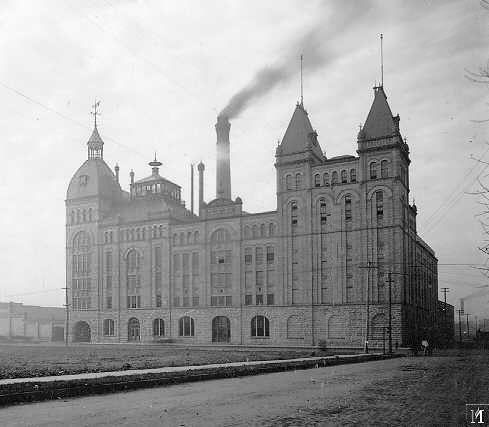
In 1893 the breweries reincorporated under the name Minneapolis Brewing Company, the same year that a new line of beer was rolled out: Grain Belt.  Grain Belt became a huge success in the Upper Mississippi River Valley, and became Minneapolis Brewing's flagship beer. Unfortunately for the fortunes of the Minneapolis Brewing company, the puritanical forces of America had seized the country and found it's whipping boy in alcohol. Prohibition stopped the production of Grain Belt, while the brewery switched to producing Near Beer (ugh, the very thought!), malt syrup, and soft drinks.In 1933, America came to its collective senses and Grain Belt was brewed once again.
After prohibition, beer drinkers preferences began to shift away from the corner bar an into the home, aided, in part, by the spread of electric refrigerators. Grain Belt introduced take home bottles (they already had returnable long-necks), as well as cone top cans that opened just like bottles. Around this time Grain Belt erected a large 40'x40' sign on Nicollet Island with a bottle cap behind its trademark red diamond logo. The sign still greets motorists driving across the Hennepin Avenue bridge just outside of downtown Minneapolis, although it is no longer lit up.
 After World War II, beer consumption at home continued to increase, as well as a preference for a smooth lager. In response Grain Belt launched the "Premium" beer, a golden lager that came in clear bottles. This is the Grain Belt that most of us are familiar with today. "Premo" was slightly more expensive, but it was a huge commercial success and became a staple for the brewery, igniting years of growth, despite its proximity to the brewing titans in St. Louis and Milwaukee. By the end of the 1960's, Grain Belt was the 18th largest brewer in the country and the company had changed its name to the Grain Belt Breweries.
  In the 1970's Bud and Miller were stepping up their advertising and marketing campaigns and regional brewers like Grain Belt were feeling the pressure. Amidst financial troubles in 1975, the shareholders agreed to sell the company, and by the end of the year the company was out of business and the once mighty brewery was closed. By 1976, both the original Grain Belt and the new Premium brand were acquired by Heileman Brewing of La Crosse, Wisconsin, and were being brewed at the cross town rival brewery, Schmidt, in St. Paul.
Under Heileman, Grain Belt took a back seat to Schmidt, and of course, Heileman's flagship, Old Style. Marketing was stepped down, packaging was downgraded, and the recipe was changed. During the 1980's, Heileman began to have it's own financial problems, and closed the Schmidt plant at the end of the decade. Fortunately, the Grain Belt brands were purchased away from Heileman and reincorporated under the Minnesota Brewing company name. By 1991, Grain Belt was once again being produced in St. Paul.
Once reinvented as Minnesota Brewing, the old Grain Belt recipes were brought back. Although the brand's reputation had taken a nose dive under the Heileman leadership, Premium's resurgence was helped along by winning Best American Lager at the Great American Beer Festival in Denver. "Premo" was jumped on by old fans and Twin Cities hipsters, but it wasn't enough to be profitable in a sea of giant macros and ever-expanding micros. The company was soon bankrupt. Again, Grain Belt received a stroke of fortune. Another local Minnesota brewer, August Schell of New Ulm, decided to purchase the Grain Belt brands. Although the original Grain Belt Golden has been phased out, Grain Belt Premium has flourished under Schell, and is to this day still available throughout the Upper Mississippi River Valley. Among the regional breweries of yore, Grain Belt is a bit of a success story: it's still around; it's still brewed in it's home state; it's still independent; and, it doesn't taste like shit. Next time you are in the Twin Cities, ask for a "beer of exceptional quality," toss back a "Premo," and taste some history.
