 Our beers of the week here have been heavily focused on American brewers, mainly from Wisconsin and California, but our friends across the pond invented the brewing game, and certainly can still make a proper ale.
Fuller's brewery, properly known as Fuller, Smith, & Turner, is headquartered in West London's Chiswick district on a site where beer has been produced for over 350 years. FS&T produce a wide variety of award winning British styles, including their flagship "London Pride," a "London Porter," and our BOTW, "Fuller's ESB." If you need a refreshment on ESBs, we discussed them back here.
Fuller's ESB has always been a good beer to quaff during winter, as it was actually introduced as a winter beer in 1971 to replace a now defunct beer called Old Burton Extra. ESB has all the elements of a good winter brew: a solid ABV at 5.5% (strong for a British draught), a strong malt base, and noticeable but balanced hop back (in this case the traditional Kent Goldings and Fuggles hops).
The beer pours a rich beautiful deep amber color with a minimal white head that fades away, but leaves a white ring throughout. It has a rich toasted biscuity maltiness, even revealing a hint of Oktoberfest-like caramel. For a member of the pale ale family, this bitter doesn't have much bitter bite. The hops are there, but you can tell they've been used more so for flavoring than for bittering. The mouthfeel is smooth and creamy with just the perfect amount of carbonation to let the flavors shine. I recommend getting it on tap when you have the chance.
Very British, and very excellent.
Links of Interest:
Fuller's
Friday, January 25, 2008
Beer of the Week


Tuesday, November 6, 2007
Jack Frosted Mugs
The mercury is finally starting to drop here in the upper midwest; we saw snowflakes yesterday! So, in anticipation of that first onslaught from Old Man Winter (which us seasoned Midwesterners know can come at any time now), it's time to suggest some good brews for winter.
To me, a good winter beer is full-bodied and malty. It doesn't have the intense hops of an IPA or APA, nor is it light and crisp like a Pilsner or an American lager. A good winter brew is hearty, malty, and satisfying. It doesn't have to be drank at a cold temperature, and it pairs well with the savory meals and treats of the holiday season. With that in mind, to the beer! Capital Winter Skål - Middleton, Wisconsin
Capital Brewery, located in the Madison suburb of Middleton, is an all-around excellent brewery. Focusing on the German styles brought over to Wisconsin from the old-world, Capital produces solid annuals like their Wisconsin Amber and Island Wheat, and a bevy of seasonals including a great domestic Oktoberfest, and their Winter Skål. The Skål is a rich amber color with an off-white head. It has a very malty aroma with very little hops present. The taste is earthy with a balance of subtle spice. Skål is a nice medium bodied brew that clings to the palatte, but doesn't have the "chew your beer" feel, or the rediculous spices you'll find in some other winter beers.  Summit Winter Ale - Saint Paul, Minnesota
I'm hardly one to recommend something from Summit; their flagship Extra Pale Ale, the IPA, and the Grand Pilsner are all easily surpassed by many domestic breweries, but I have to hand it to them: Summit Winter Ale is good. It pours a very dark, coffee brown, which is accompanied by a subtle coffee taste. The roasted malts are very noticeable in a "winter warmer" style, but are subtley balanced by Williamette, Fuggle and Tettenanger hops. The beer comes in a 6.2% ABV, but beneath the malt start and hop finish, you don't notice an alcohol flavor. This is far and away Summit's best beer. McEwan's Scotch Ale - United Kingdom (Scotland)
Clocking in at 8% ABV, McEwan's Scotch Ale is an example of a strong scotch ale, or a "wee heavy." It isn't a winter beer in the sense that it is a winter seasonal (it's brewed year round), it's just a good brew to have in winter. McEwan's is a deep copper and is a carmelly, malty sweet delight. Are there hints of cola in there? There are definitely hints of alcohol in there. Like most Scotch beers, this one doesn't have the hops as bittering agents; it's smooth and solid. It may not be a winter seasonal, but it will sure warm you up.
Links of Interest:
Capital Brewery
Summit Brewing
Wednesday, October 31, 2007
Pale Ale, Pt. II
Yesterday we began our dissection of the term "pale ale" with a brief history of the emergence of the term, and subsequent tweaking to get India Pale Ale (IPA). I mentioned at the end of the article that legendary brewer Bass had copied Hodgson's pale ales to gain access to the Indian market (in part due to loss of the Baltic market because of the Napoleonic War). "But wait," you might say, "Bass doesn't taste like an IPA. It might be a pale ale, but it tastes more like a North American Amber Ale." Well read on dear beer-lover, there are explanations for this.
First, to quote the old Olympia slogan (a low-rent beer from the Pacific Northwest that was eventually bought by Miller and closed in 2003), "It's the water." Bass was brewed in Burton-on-Trent, where the water has a very high sulfate content. The nature of the hard water allowed Bass (and others) to use high hop levels without getting a piercing bitterness. According to brewingtechniques.com: The secret to the Burton brewers' success came from the water, an ingredient often downplayed in beer recipe formulation. The sulfates of the Trent basin helped the Burton beers achieve their clarity and bitterness and allowed the Burton brewers to far exceed Hodgson's India Ale in clarity, hopping rate, and marketability. The high sulfate content allowed brewers to use hopping rates well beyond that compatible with the carbonate water of London. Sulfates actually change the mouthfeel and perception of bitterness. High sulfate content results in a sharp, clean bitterness, unlike the harsh clinging bitterness of highly hopped beers brewed with water high in carbonates.
Second, while IPAs have shown a considerable boom in the United States in the last 20 years, there is some varience within the style, and thus some varience in the American thought of what an IPA is. Additionally, modern British IPAs are not really true IPAs at all, and are in fact more like English bitters. More on bitters later, but first you're probably getting thirsty. Allow me a suggestion for what I think is a good representation of what these original IPAs were. A balanced IPA that is high in hop aroma and alcohol, yet has some malt complexity to balance it out, is Anchor's Liberty Ale. Introduced in 1975, this San Francisco based beer is between gold and amber in color, and uses top fermenting ale yeast. Additionally the beer is dry-hoppped, with hops added to the brew during maturation, a process that was often done in the old days for insurance against microbes before a long sea voyage. Despite the dry-hopping, this isn't a "hop for the sake of hops" brew, as it is just slightly sweet, balanced with malt and a nice diversion from the hop-bomb ales of the West Coast. Put this one somewhere between Bass, and the American hop-drop kick. Now back to the story.
With IPAs emerging as their own style, there needed to be an easy differentiation between these pale ales and the beer being produced for the English domestic market. While many brewers continued to market their pale ales, pubgoers came up with a new name to separate them from IPAs and the Burton exports: bitter.
The term "bitter" for a type of beer grew directly out the development of pale ale. The pale ales produced for sale at home were generally lower in alcohol and hops than their IPA counterparts, and didn't need the maturation process that an IPA did. They were "running" beers and could be served after just a few days in a cellar. Somewhere in the middle of the 19th century, the terms pale ale and bitter were used interchangeably in the UK.
As bitters evolved into an entity onto themselves, variations emerged within the style. Bitters can be almost as dark as a stout, or approaching a golden ale, although they are generally a deeper bronze or copper color. There are best bitters, special bitters, and extra special bitters (ESB), which ususally signifies different alcohol levels. There is no general agreement as to what constitutes "ordinary," "best," or "extra special," in bitters, and there can be varience from brewery to brewery.
Bitter is used much less frequently in the US versus the UK (although ESBs are easy to find), and generally refers to a pale ale with a lower hop content than the typical American pale ale (APA).
More on bitters and APAs tomorrow.
Links of Interest:
Anchor Brewing
www.brewingtechniques.com
Tuesday, October 30, 2007
IPA, APA, ESB, WTF? (Pale Ale, Pt. I)
With so many beers out there claiming to be “pale ale,” how does one know what to expect in a brew? There are India Pale Ales, American Pale Ales, Extra Pale Ales, Bitters, the list goes on. In the next couple of installments, we’ll get to the bottom of the history and stylistic variants of the pale ale, and offer some recommendations too.
The matriarch of this family of beer can be traced back to England, where brewers were looking to develop a more consistent and paler variety of ale. Unfortunately, the wood kilns used to roast malts often produced off-flavors and very dark malts. When coke was produced from coal in the 18th century, it allowed for a high heat pale malt that could be produced consistently. These original pale ales were a notable departure from the sweet English brown ales, as well as the dark porters, and were enjoyed by drinkers as far back as the 1750’s.
An export problem created the first split in the pale ale family tree, when British brewers were trying to overcome the long shelf life and resistance to temperature fluctuations that would be needed in brew headed to their tropical colonies, especially India. Continual rocking and high temperatures were not friendly to British browns and porters, not to mention chugging a porter in the Indian heat doesn’t sound all that appealing, does it? Shipping rates to colonial India were low (thanks in part to the value of silk and spices that could be shipped back), so the brewers that came up with a solution to the sea voyage would be rewarded handsomely with profit.
The solution was found in brewing a pale ale that had a higher alcohol content and more hops, which made it inhospitable for microbes. The beer also matured during the long voyage, giving it a flavor all its own. This recipe tweak is purportedly attributable to George Hodgson, who was subsequently copied by many brewers, including the legendary pale ale brewery Bass, and the India Pale Ale, or IPA, was born.
More splits in the pale ale tree to come tomorrow. Stay tuned!
Wednesday, October 17, 2007
Black & Tan
 All this talk of stouts has reminded me of one of my favorite bar beverages I pull out of my beer repertoire occasionally when seeking variety: the Black & Tan. A Black & Tan is a mix of any stout or porter and a lighter ale or lager.
Many Americans know a Black & Tan as a mix of Guinness and Bass, separated for visual effect by pouring the Guinness over a teaspoon. The nitrogen carbonation (nitrogenation?) of Guinness versus the traditional carbonation of Bass allows the Guinness to perch atop the “cocktail” for the duration of the drink.  An additional twist on this beer cocktail is the Half & Half, which substitutes Harp Lager for Bass Ale. The name change is not just to differentiate the use of a Harp versus a Bass, but has specific political connotations as well. The Black & Tan were a paramilitary force used by the English to suppress the Irish independence movement. While supposedly deployed to fight the Irish Republican Army, the Black & Tans developed a reputation of harassing and assaulting civilians as well. Additionally, Bass is an English beer, while Harp is an Irish beer. In this light it’s easy to see why Irish pubgoers are not exactly lined up around the block to order a Black & Tan.
 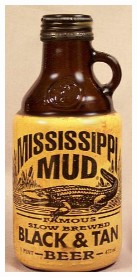 Black & Tans don’t have to come in the form of Guinness and Harp or Bass, in fact many are already premixed. Mississippi Mud, produced in Utica, NY is an all-American black and tan that doesn’t require special bartender teaspoons, or even a glass to be enjoyed. It’s certainly not the best B&T I’ve ever had, but it’s hard to resist drinking out of that widemouth “white lightning” jug. For a Midwestern example, try Gray’s Black & Tan, from Janesville, Wisconsin, another example of a premixed.
If you’ve never experience the flavor and sight of a black and tan, I suggest you order one the next time you find yourself in an Irish pub. The visual effect alone is enough to justify the purchase.
Also, I’m putting bass.com as one of the websites below, but navigate at your own peril. It made me feel like I’d had a few B&Ts when I went there.
Links of Interest:
Guinness
Bass
http://www.irish-society.org/Hedgemaster%20Archives/black-tans.htm
Monday, October 15, 2007
Now that's a Stout Porter!
It was a good weekend for beer. Amber and I went to a beerfest in Wisconsin Dells called: “Wisconsin on Tap”. The event featured 27 Wisconsin microbreweries and Goose Island, a Chicago based brewery that got in on a technicality: they have “Wisconsin distribution.” I like some of Goose Island’s beers but we did not approve of them sneaking into a Wisconsin only beerfest, and didn’t drink any of their beers in silent protest. We’ll have a full review of the event later in the week, but to prepare you for some of the highlights I’ve decided to give some background on a type of beer perhaps less common than traditional ales and lagers, at least in the United States: stout.
When I first began drinking beer, I didn’t know that porters and stouts were essentially the same thing. I knew they were both similar in taste and appearance, but in my ignorance I assumed they were produced in different ways; although there are different types of stouts/porters, they are essentially of the same family.
Porters first arose in England sometime between 1730 and 1750, depending on who you ask. While some argue that the name porter came from the dark beer’s popularity among workers who carried food and goods through London, others dispute the authenticity of such notions, including Michael Jackson (the legendary beer critic, not the moonwalker). In any case porters were dark beers that generally used more roasted malts.
Brewers often made several different strengths of porter and would use certain adjectives to differentiate between the styles. Stout, long used as an adjective for “strong” beer, was used to designate strong varieties of porter. In fact, Guinness, perhaps the most well known stout in the world is a variety of porter. In 1799, the Arthur Guinness brewery stopped making ale and decided to focus efforts on its porters, one of which, the Guinness Extra Superior Porter, is the precursor of today’s Guinness Original and Guinness Extra Stout. Guinness produces dry or “Irish” stouts, but there are other varieties of stouts as well: imperial or “Russian” stouts, coffee, oatmeal, chocolate, milk and Baltic.
More to come on stouts when we discuss the Wisconsin on Tap beerfest. Now, go to your local Irish watering hole and enjoy some flavor and history by chugging a few pints of the black stuff (in moderation, of course).
Link of interest:
http://www.guinness.com
http://www.beerhunter.com/documents/19133-000041.html
http://wisdells.com/WisconsinDellsAttractions/autumnharvestbrewers.cfm
