Showing posts with label Minnesota Beer. Show all posts

Monday, September 13, 2010

Beer of the Week


Over the past six months I have found a love of sour and wild beers. A stand out amongst crowd has been Flat Earth’s Extra Medium. Flat Earth, a St. Paul brewery which has been featured by us before, has done it again with this sour cherry beer.

I first got to try this tasty brew at the Muddy Pig and it has had a place on their taps as well as my heart for the past few months. Muddy Pig has become a frequent hang out for Ryan and I since our move to St. Paul and bringing great beers like Extra Medium is why. This is the description from Flat Earth's website:

This American wild ale was brewed using a blended strain of yeast that created this unique and refreshing beer. Brewed in the summer and allowed to age in an unjacketed tank for a year to fully develop its flavors. Extra Medium has an aroma of tart cherries, lemon and a slight inner city funk. It is refreshingly tart and sour with hints of orange marmalade, whiskey and citrus rind. Extra medium pairs well with salads, pungent cheeses and angel food cake.

The first thing that grabs you is the rich red color of this cloudy beer. The smell is an intoxicating blend of pungent yeast with notes of cherry, cranberry and apple cider vinegar. The carbonation is light which I prefer in sours. The taste is full a bodied sour cherry, with a yeasty vinegar and lemon notes. The sour taste is there but blends nicely with some malty sweetness.

This is an everyman’s kind of sour as opposed to some of the stronger tasting varieties. Wild but still palatable. If you haven’t been able to get into sours or wild beers I strongly suggest this one to help you appreciate the style.

Links of Interest:


Digg this

Tuesday, August 3, 2010

Beer of the Week

Summit Brewing of Saint Paul is now on the fourth installment of their "Unchained" series.

Judging by the strength of the series, Summit should have come unchained long ago. While some of the Summit fleet seem like afterthoughts (IPA, Grand Lager), you can taste the passion in the Unchained series. The Koelsch is particularly good and has been receiving praise from across the beer community.

This week's BOTW is Unchained #4, a Belgian Style Golden Ale. It pours a straw color with a small white head somewhat smaller than other Belgian Golds (which tend to have giant heads).

The smell is fruity, yeasty and sweet. What are those fruits in there? Pear? Grape? There is definitely a hint of banana. There is a lot going on in the nose of this beer.

The taste is like the smell: fruity and sweet. Besides the sweetness, the beer has a complex yeast taste that is true to style. I think I can pick up subtle toffee notes from time to time.

While some Belgian Golds have a strong aftertaste, this one is relatively crisp. The pleasantly mild aftertaste makes this brew go down quickly.

My main complaint with this beer is that it is too sweet. Did the yeast not eat enough of the candi sugar? A little extra fermentation might add to the strength (literally) of this beer. Overall, another worthy effort in the Unchained series. I can't wait for #5.

Digg this

Tuesday, June 22, 2010

Pack It In

It's summer in the upper-Midwest, and for those of you like me, you want to seize this precious 6 weeks and cram in as much outdoors time as possible.

When it comes to "drive-in" camping, one doesn't have to put much thought into what beer to bring: if it fits in the cooler, it works. When it comes to day-hikes, backpacking, or boating, however, one has to plan a little better.

With hiking, beyond the obvious concern of weight going in (glass is heavier than cans), you have to consider the weight coming out. With hiking or boating, you certainly don't want to leave your trash behind (or toss it in the lake), so whatever you "pack in" you'll have to "pack out." This again, suggests that canned beers are the preferable hiking beers. Finally, bottles break. You don't want broken glass in your pack or in your boat. Bottom line: start looking for cans.

Unfortunately, many, if not most craft beers fail to offer their wares in cans. Fortunately, there are some craft offerings that are both delicious and canned.

BEER ON THE BRAIN'S 2010 HIKING/BOATING BEER GUIDE:

1. Dale's Pale Ale - Oskar Blues (Colorado)

Oskar Blues was the pioneer in canning craft beer. Since 2002, Dale's Pale Ale, Oskar's signature ale, has been offered only in cans.

This American Pale Ale has a nice citrus/grapefruit hops nose and a slightly sweet bready malt body. It's bitter, with a clean hop finish that's perfect on a hot sunny day. Lots of flavor, but not too heavy.

2. Surly Cynic - Surly Brewing (Minnesota)

Surly is a staunch advocate of canned beer, choosing to release their entire line of award-winning craft brews in cans.

The Cynic is a Saison/Farmhouse style ale and pours a rich vibrant gold. You can smell some Belgian-style yeast notes as well as some coriander and spice. The beer has a medium body, smooth, with the perfect level of carbonation. Being Surly, there are a bit more hops in this one then you'll find in others of the same style. Great for a hot day. If you can find a better Saison in a can, well, if can find another Saison in a can, you'll be lucky.

3. Brew Free or Die IPA - 21st Amendment Brewery (California)

Although founded in 2000, 21st Amendment has only recently found its way out the Midwest. We're happy it made it out here. With a six hop punch in the nose, and a nice balanced malt back, their IPA is another solid offering from the Left Coast. Bonus for us flyover-land hikers and boaters? It comes in a can and is generally cheaper than the aforementioned beers.

Honorable Mentions:

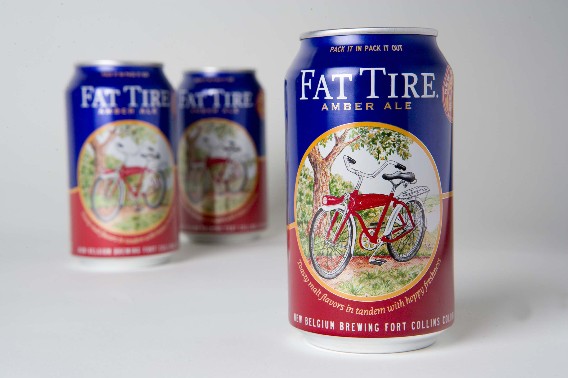
Fat Tire - New Belgium Brewing (Colorado)

New Belgium's flagship is also available in a can. Surprisingly, should you take the time to pour one out, it tastes better out of the can, then out of the bottle! This is no coincidence. As Bon Appetit puts it, "New Belgium adds a slurry of active live yeast to its Fat Tire cans just before sealing to take up oxygen and prevent stale off-flavors. The result is a fresher, more complex beer. Think of it as a mini keg."

Hamm's Lager - Hamm's (Wisconsin)

It might be owned my MillerCoors now, but those of us in the "Land of Sky Blue Waters" still know that a Hamm's tastes great out on the canoe. Lest you think I'm succumbing to nostalgia and clever marketing, Hamm's won the gold for best American Lager at the Great American Beer Festival in 2007.

Digg this

Friday, July 24, 2009

Summit Unchained

Attention Midwest beer lovers: there's a new series of limited edition brews headed your way.

Summit is offering up a limited series of beers called their "Unchained" series. The first offering is to be an authentic German Kölsch.

Kölsch, unlike most of its German cousins, is not a lager. The beer is actually top fermented at relatively warm temperatures, like an ale. Although it is often stored for a period of time, or lagered, it is not technically a lager.

Much like tequila, champagne, or cognac, technically only beers from Köln (Cologne) can bear the Kölsch designation. A 1986 German law limited production to Köln and a few nearby breweries that were grandfathered in. The designation was eventually extended to the entire EU.

Indeed, referring to Kölsch brewed in the U.S. the Wikipedia page notes that:


While the labeling of these brews as Kölsch may be legal in local law, it is certainly misleading, as Kölsch-style ales brewed outside the Cologne area are not guaranteed to use the same ingredients and brewing processes, and might therefore differ in their flavor and aroma profile. Further, they may not be compliant with the Provisional German Beer Law, the current implementation of the Reinheitsgebot.


It may be a concern for some folks, but it shouldn't be for Summit drinkers. According to the Brewery:
...we have used only the most authentic ingredients available to produce this beer. We have used 100% imported German malt; a blend of Pilsener and Kölsch malts from the Global Malt cooperative (a cooperative of 3 German Maltsters with a combined 6 maltings headquartered in Osthofen) and a small percentage of Caramalz from the Weyermann maltings in Bamberg. The hops we have used are also imported from Germany and are only grown in the Hallertau region of Bavaria. Hallertau Mittelfrüh are some of the most delicate, distinctive and highly prized hops in the world. Finally, we will be using traditional top fermenting Kölsch yeast obtained from the world-renowned yeast banks at Weihenstephan in Bavaria.


I don't know about you, but I'm getting thirsty just thinking about it!

Digg this

Monday, June 16, 2008

Beer of the Weekend

There was no beer of the week last week, so of course, I have to deliver something special for the Beer of the Weekend. Well hold on to your hats, ladies and gentlemen, because I'm about to say the unthinkable:

Summit's Hefe-Weizen is better than this years batch of Bell's Oberon.

I'm no fan of Summit, and though truth be told, I think Bell's is a little overhyped, but Summit's Hefe this is year is truly tasty, and this year's Oberson is nothing special.

At first, I thought possibly it was just me; that maybe I was judging poorly, or maybe I got a few bad taps; however, after several Oberons on beautiful days, I have to admit that it's been better in the past. I'm not sure what it is, but it doesn't seem to have as much aroma, nor enough hops bite. Looking to the future, next year's may also suffer.

I still like Oberon, but Summit's Hefe is just a little better. It has a really nice fruity aroma, a properly carbonated body, hints of banana in the flavor, and a crisp hops finish. If I could make one critique, it's that the color is a little too light. It's still not of the magnitude of a Franziskaner, but it's darn good.

Links of Interest:

Summit Brewing

Digg this

Friday, April 25, 2008

Beer of the Week

My god, this winter has been so goddamn long that I'm starting to lose it. I feel like I live in Canada, except that I don't have guaranteed health care and I never got good at hockey. It's a good thing that Minnesota has finally started cranking out some decent brews to get us northwoods faithful through.

Flat Earth Brewery, a new St. Paul brauhaus that I mentioned back here, has been quietly invading bars and liquor stores around the Twin Cities Metro. Last night I had the good fortune to share a few pints with a good friend at the Sample Room, a Northeast Minneapolis institution of which Chef and TV Personality Anthony Bourdain had this to say:

that's another good one. I'm sure his business model wasn't, 'There's a huge demand here for traditionally made pâté, so I'm opening!' It was more like, 'I love pâté, I want to make it old-school, I'm going to create the market and hopefully people will join me.'


Indeed the Sample Room prides itself on its homemade and interesting foodstuffs, and takes equal care to make sure their taps are interesting and fresh. As a local, fresh, and delicious brew, Flat Earth's Belgian Style Pale Ale made the cut.

The beer pours a clear and beautiful amber color with a minimal white head that leaves considerable lacing along the way.

The beer has a faint yeast smell mingling with a sweet fruit aroma. It has a very dynamic nose that refuses to fade as one is drinking the beer.

A medium body ripe with tight bubbles awaits you as you quaff the ale, greeting you with a little yeast up front, some carmelly biscuity malts in the middle, and very subtle finishing hops in the back. The malts will hang on until the finish, but the final taste is quite dry, with notes of grain.

The alcohol is a touch low for the style at 5.2%, but that makes this beer all the more chuggable, with enough flavor to keep you coming back, but not too much as to overwhelm the senses.

Congrats to Flat Earth.

Links of Interest:

Flat Earth

Digg this

Friday, March 28, 2008

Beer of the Week

In homage to my new home, this week's beer comes from a suburb of Minneapolis, courtesy of Surly Brewing Company.

Surly is relatively new to the brewing game, having been on the scene for about two years, but has started with a bang. The young brewery has been featured in Gourmet magazine and was rated the #1 brewery in America by Beeradvocate magazine, quite the praise.

Surly produces two year-round brews, and both are excellent. Furious is a solid, medium bodied, well hopped ale, and Bender is our BOTW.

According to Surly, the Bender is an amalgamation of styles: part porter, part brown ale, part APA. After a few Benders at the bar last night, I decided that Brown Ale is the tag that a beer gets when the brewers don't know what the hell to call it, likewise with Amber Ale.

This brown ale is a little browner than one might expect, pouring an almost black color with a nice off-white head.

One definitely picks up hops in the aroma, but it doesn't slam you in the face, which considering the style, is not a bad thing. There's definitely some oatmeal in the nose, almost like an oatmeal stout. Surly says the oatmeal is for smoothing out the finish, which it does, but it also gives it quite a pleasant smell.

The beer has a nice medium body with almost perfect carbonation. It has a nice defined presence, but you don't have to work to get it down. Its perfect body and 5% ABV make it an outstanding session beer, keeping you coming back for more.

The brew has a solid roasted malt base with the oatmeal really smoothing it out and mingling with the hops at the end of the taste. The beer is complex yet crisp, easy to drink, yet satisfying: a true acrobat in the art of brewing balance.

Surly is only available in the immediate area, so if you're outside of the Twin Cities or Duluth, have someone send you some, or better yet, come to Minneapolis and raise a few pints.

Congrats to Surly Bender as our Beer of the Week.

Links of Interest:

Surly Brewing Company

Digg this

Tuesday, November 6, 2007

Jack Frosted Mugs

The mercury is finally starting to drop here in the upper midwest; we saw snowflakes yesterday! So, in anticipation of that first onslaught from Old Man Winter (which us seasoned Midwesterners know can come at any time now), it's time to suggest some good brews for winter.

To me, a good winter beer is full-bodied and malty. It doesn't have the intense hops of an IPA or APA, nor is it light and crisp like a Pilsner or an American lager. A good winter brew is hearty, malty, and satisfying. It doesn't have to be drank at a cold temperature, and it pairs well with the savory meals and treats of the holiday season. With that in mind, to the beer!

Capital Winter Skål - Middleton, Wisconsin

Capital Brewery, located in the Madison suburb of Middleton, is an all-around excellent brewery. Focusing on the German styles brought over to Wisconsin from the old-world, Capital produces solid annuals like their Wisconsin Amber and Island Wheat, and a bevy of seasonals including a great domestic Oktoberfest, and their Winter Skål. The Skål is a rich amber color with an off-white head. It has a very malty aroma with very little hops present. The taste is earthy with a balance of subtle spice. Skål is a nice medium bodied brew that clings to the palatte, but doesn't have the "chew your beer" feel, or the rediculous spices you'll find in some other winter beers.

Summit Winter Ale - Saint Paul, Minnesota

I'm hardly one to recommend something from Summit; their flagship Extra Pale Ale, the IPA, and the Grand Pilsner are all easily surpassed by many domestic breweries, but I have to hand it to them: Summit Winter Ale is good. It pours a very dark, coffee brown, which is accompanied by a subtle coffee taste. The roasted malts are very noticeable in a "winter warmer" style, but are subtley balanced by Williamette, Fuggle and Tettenanger hops. The beer comes in a 6.2% ABV, but beneath the malt start and hop finish, you don't notice an alcohol flavor. This is far and away Summit's best beer.

McEwan's Scotch Ale - United Kingdom (Scotland)

Clocking in at 8% ABV, McEwan's Scotch Ale is an example of a strong scotch ale, or a "wee heavy." It isn't a winter beer in the sense that it is a winter seasonal (it's brewed year round), it's just a good brew to have in winter. McEwan's is a deep copper and is a carmelly, malty sweet delight. Are there hints of cola in there? There are definitely hints of alcohol in there. Like most Scotch beers, this one doesn't have the hops as bittering agents; it's smooth and solid. It may not be a winter seasonal, but it will sure warm you up.

Links of Interest:
Capital Brewery
Summit Brewing

Digg this

Thursday, November 1, 2007

Pale Ale, Pt. III

Two days ago we started our exploration of the genesis and development of the pale ale world, which included the development of the India Pale Ale (IPA). We followed that up yesterday with an IPA recommendation, a Burton brewers overview, and an introduction to English Bitter. Today we continue on our IPA-like voyage to unravel the term pale ale, talking more about bitters, and the American pale ale (APA).

As I mentioned yesterday, bitters are less common stateside, and are sometimes found masquerading as a plain "ale" or simply as an "ESB;" however, bitters, both in name and style can be found.

Nestled between downtown Minneapolis and the University of Minnesota is Town Hall Brewery. Town Hall is a bar-lovers bar. It has lots of dark wood, a proper food selection, beer specials, a huge scotch selection, pool by the hour, and a great patio. Additionally they have a few good brews. The West Bank Pub Ale is so named for a section of the city on the west side of the Mississippi River, and it used to go by the name West Bank Bitter. While it is perhaps more hoppy than other "mild" ales, it has a nice malt balance. It has an alcohol content of 4.6% (which might fall into the "best" category of bitters in the UK) and is what Town Hall calls their "session beer" (you can have a few and not get totally munted). The beer has smooth medium bodied mouthfeel, and is a rich copper hue. If you're in Minneapolis, swing by Town Hall for an American example of an English bitter, and try the award winning Oatmeal Stout while you're there.

So where does the APA fit into this?

Knowing the brashness and ingenuity of Americans, it should come as no surprise that American brewers would not be content to simply adopt the brewing traditions of the old countries...not without a few tweaks that is. Early Dutch and English brewers brought over their traditions of ales and porters, but later, Central European immigrants did the same. Brewing innovation in the mid-19th century brought the pale lager and pilsner to the fore, and the popularity of this beer spread from Germany and Bohemia all over Europe and to the United States. These pale lagers began to dominate the US market and could be produced easily using indigenous grain like corn. Towards the end of the 20th century, the early traditions of American ales had all but vanished. Simultaneously, consolidation and taxation were doing a number on the other side of the pond, and British ale crafters were disappearing or producing low alcohol bitters. The ale traditions of early America were in serious jeopardy: enter the California ale revolution.

The San Francisco based Liberty Ale mentioned in yesterday's column was Anchor Brewery's attempt at a real ale. First produced in 1975, it emerged as one of the first (if not the first) known examples of a commercially successful ale produced in the US in quite some time. Just a few years later in 1980, a brewery in Chico, California produced what would become what many consider the prototype of the APA, Sierra Nevada Pale Ale.

Sierra Nevada Pale Ale has a truly American flare, using Cascade hops, giving the brew a dry, floral character, without the carmelly malt back of a British pale ale. This unabashed "in-your-face" hop flavor is a characteristic of the APA, which is drawn in part from using native hops. Sierra's is in the middle of the color range for what you might find in an APA, and has been a huge commercial success. Sierra Nevada has since expanded their brewing facilities and produces many other quality brews including an IPA and a Porter. Breweries like Anchor and Sierra Nevada helped prompt the huge agricultural boom of hops in the Willamette and Yakima valleys, further expanding the possibilities for unique American ales.

APAs are almost synonymous with the craft brewing explosion of the last twenty years, so go to your local beer depot and find a local example. For a Midwestern example, try the Great Lakes Burning River Pale Ale, made in Cleveland. It's not my favorite, as many of the West Coast breweries do it better, but it's worth a try.

Links of Interest:
Sierra Nevada Pale Ale
Great Lakes' Burning River

Digg this

Thursday, October 25, 2007

Good News for MN Beer Lovers

Having lived in the great state of Minnesota for 8 years, I know first hand that the state suffers from a severe lack of craft brewing. The two large independent breweries, August Schell of New Ulm, and Summit Brewing of St. Paul, are woefully inadequate at satisfying the needs of a discerning and thirsty populace.

Well there is a star on the horizon Minnesotans. At this year's Great Taste of the Midwest (held annually in Madison), we had the good fortune of sampling the wares of a new St. Paul suds producer, Flat Earth Brewing Company. We sampled the Bermuda Triangle Tripel, which was a tad sweet for my liking, however good, but Amber found it excellent.

Today is a big day for Minnesota and Flat Earth, as Chisago Lakes Distribution picked up 100 cases of their Belgian Pale Ale in 22oz. bottles. Where are these 22's going? According to Flat Earth the full scope is not known, but here is a quick list: Cellars - Roseville, Cellars - St. Paul, Cellars - Eagan, Cellars - Plymouth, Princeton's - Maple Grove, Surdyk's - Minneapolis (Next Week), Dolce Vita - Chaska (Next Week).

Drink up Twin Cities!

Links of Interest:
Flat Earth Brewing

Digg this