 We started a discussion of lagers on Tuesday, but of course, there is much more to say.
As I mentioned, lagers have been brewed in central Europe for the last 500 years. In fact, in the days before refrigeration, Europe was divided into ale and lager regions: the mild climates of England and Belgium lending themselves to ales, and the mountainous inland regions of Bavaria and Bohemia lending themselves to lagers.
Like ales, there is not just one variety of lager, though you will often times find beers labeled as if there were. There are bocks, maibocks, doppelbocks, Munich helles, dunkel, oktoberfest, pilsner and more.
Leading up to the Beer of the Week, we'll focus on the pale lager family for now. Pale lagers encompass the vast majority of commercially successful beers around the world, from Miller High Life to Red Stripe to Heineken; however as any beer drinker can tell you, there are considerable differentiations even within this family.
The birth of pale lager begins in one of the points of the "golden triangle of brewing," Munich, Germany (the other two points being Plzen, a.k.a. Pilsen, and Vienna). In the mid 1800s, Spaten Brewery of Munich was run by Gabriel Sedlmayr. Mr. Sedlmayr embarked on a tour of Europe to see what the brewing world had to offer, in the hopes of improving his own brewery's techniques. He brought back some of the pale malt stylings of the pale ale brewers in England and applied them to his brewery. It wasn't an overnight success, but Joseph Groll, another German brewer, took some of these techniques over to Plzen, Bohemia (now the Czech Republic) and created what would be an overnight success, a revolution in brewing that will probably never be topped.
As the story goes, the brewers of the city of Plzen dumped a whole batch of ale into the river, that they agreed had been contaminated by wild yeast, bacteria, or both. They decided to take advantage of some of the new techniques being used in nearby Munich to make more stable beers.
Groll was hired to bring the German lagering method to the thirsty citizens of Bohemia, and arrived to find an ample supply of hops, lagering caves, and the proper yeast needed to make a good lager. Groll didn't settle for the same old style they were making over in Deutschland, he upped the ante.
Groll eliminated the roasted barley, and kicked the hops up a notch. The resulting brew was golden, crisp, and refreshing. The uniquely clear and golden beer was so popular that the brew and the technique spread, eventually acquiring the name of the city, Plzen, or Pilsner. Pilsner Urquell, still brewed to this day in Plzen, is the result of Groll's ingenuity.
We can talk more about Pilsners later, but needless to say, it was a huge success. Nearby brewers in Dortmund took notice and modified the style to create the Dortmunder Export style we know today, and it took a little while, but brewers back in Munich, including Spaten, took notice of Pilsner's success and made their own adaptation, known as a helles, German for "pale."
More to come on the Munich Helles variety tomorrow.
Thursday, February 14, 2008
More Lager, Please


Tuesday, February 12, 2008
Why Not Lager?
 A friend of mine, a reader of this blog asked me once, "Why is it so hard to get a good pilsner in America?" Since a pilsner is but one style of the lager family, and it seems that in the American brewing revolution, all lager beers are rare, the question might well have been, "Why is it so hard to even find a good micro lager?" The answer lies in the production methods that differentiate ales from lagers.
As you may or may not have noticed, the West Coast and Colorado factions of the microbrew scene are extremely heavy on the ale side of the fence. While most of us can appreciate a good IPA or American Amber, the divide is not simply a matter of taste.
Lager, German for "store" or "stock" (not "to age" as some people may tell you), is a family of beer styles produced in central Europe for the last 500 years. Lager is differentiated from ale in the yeast that is used to produce it. While ale yeast ferments at the top of the tank at warm temperatures, lager yeast ferments at the bottom in colder temperatures.
As amazing as it may seem, this is a result of humans breeding yeasts into two ideal strains. While bakers yeast and brewers yeast were once the same thing, a long process of selectivity and mixing with wild yeasts produced the two major brewing strains we know today.
The low temperatures needed for lager beers (0-5 degrees Centigrade) mean that in order to brew these styles, the brewer must have an environment in which there is a cold and constant temperature. Unless you have access to some caves, setting up an area for this cold brewing is prohibitively expensive for home- and microbrewers.
If you are of the grassroots brewing movement, chances are you honed your skills on ales, not lagers, and your recipes and habits are suited as such. Thus, if you were to start your own brewpub or micro, you probably would not have the equipment or experience necessary to produce a decent lager.
Additionally, lagers have to be lagered...that is, stored. Lagers must be stored for weeks or even months to attain their unique flavors. Capital Brewery of Wisconsin produces a doppelbock called "Autumnal Fire" that takes nine weeks to finish its cycle; two beers I recently reviewed take an amazing nine months to finish. Therefore, it is also expensive for microbrewers to produce a beer that is sitting around a long period of time before it can be sold. The cycle is longer, eating up more of the brewery's space and resources, and making demand forecasting much harder.
The combination of difficult production conditions and storage requirements make lagers a tall order for small brewers, though many small brewers do produce good lagers. We'll talk more about the family of lagers and good lager beers later in the week.
Thursday, December 6, 2007
Drink to Common Sense
Yesterday marked the anniversary of the only time an amendment to the United States Constitution was repealed. The Twenty-first amendment was passed on December 5th, 1933, and repealed the Eighteenth amendment which had forbidden the manufacture, sale, transportaion and importation of "intoxicating beverages."  The brewing industry certainly had a role in spurring along Prohibition. In 1890, beer emerged as the leading intoxicant of choice in the US. Large brewers in Milwaukee and Saint Louis had harnessed the forces of industrialization to build huge brewing empires capable of producing large quantities of beer and distributing it nationally and even internationally. As these brewing titans expanded their reach, they butted heads, and competition grew.
Since at home refridgeration was not available at this time, most drinkers got their buzz at the local tavern. At the time, it made financial sense to have more than one bottle of whiskey on the shelf, but it was harder to keep two different tap beers fresh and flowing. Since the taverns only carried one variety of beer on tap, the solution from the brewers' perspective was to build another tavern. Saloons proliferated, often financed with brewer money, and outfitted with all manner of promotional materials. Some cities became saturated with bars, sometimes four on a corner (us Milwaukeeans can relate), which reduced demand cutting into profits for tavernkeepers. Bar owners often turned to other ways to attract drinkers: salty free lunches on the benign end of the scale, and prositution and cock-fighting on the slightly more risque side.
Taverns became viewed by some citizens as houses of ill-repute and a blight on the neighborhood. Anti-saloon sentiment helped to organize people, fueling the formation of the Anti-Saloon League, who with the Women's Christian Temperence Union, were the prime shakers in the Prohibition movement.  Another mover and shaker of the movement was the Prohibition Party, which oddly enough, still exists today. They seem to have morphed into an extremist mix of Libertarianism and Christian Theocratic rule. They are anti-abortion, anti-drug and alcohol, pro gun, anti-union, and pro gold standard. Ron Paul folks would love them, were it not for the weird religious angle and the battle against alcohol. I've linked their 2004 platform below. In all fairness, not all of their ideas are bad, just most of them.
Since 74 years ago today marks the first full day to legally chug a finely crafted brew, head to your local house of ill-repute and raise your glass to freedom!
The cartoons in this article come courtesy of Ohio State University.
Links of Interest:
Prohibition Party Platform, 2004
Wednesday, November 28, 2007
Ireland's Ancient Breweries
Is it coincidence the theories discussed were hatched after a night at the pub?
From Wired.
P.S. A "cerevisaphile" is a conessouir of ales and lagers. "Cerevisaphilic" is a made up word from what I can tell.
Friday, November 16, 2007
Pabst Americana - Grain Belt
In this series we explore the vanishing regional beers of America. Our first will be Grain Belt, of Minneapolis.
1890, four breweries, John Orth, Heinrich, F.D. Norenberg and Germania, merged and began operating out of Orth's facilities, the largest of the four. 2 years later the brewers commissioned a new building to house their facilities. Four different architectural styles were incorporated in the building to signify the four former breweries, and the result was a castle like structure that to this day sits on the bank of the Mississippi in North-East Minneapolis. The city of Minneapolis bought the structure in 1987 to prevent demolition and today the site is home to the RSP Architecture firm as well as a branch of the Minneapolis public library system.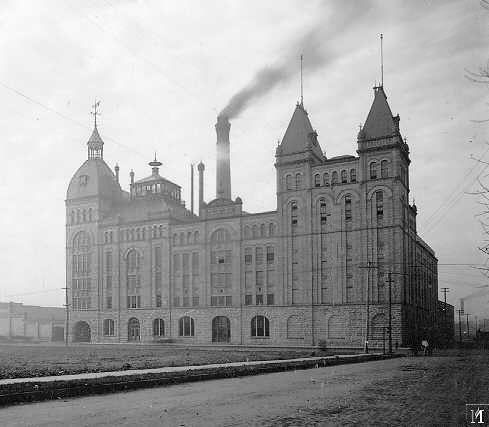
In 1893 the breweries reincorporated under the name Minneapolis Brewing Company, the same year that a new line of beer was rolled out: Grain Belt.  Grain Belt became a huge success in the Upper Mississippi River Valley, and became Minneapolis Brewing's flagship beer. Unfortunately for the fortunes of the Minneapolis Brewing company, the puritanical forces of America had seized the country and found it's whipping boy in alcohol. Prohibition stopped the production of Grain Belt, while the brewery switched to producing Near Beer (ugh, the very thought!), malt syrup, and soft drinks.In 1933, America came to its collective senses and Grain Belt was brewed once again.
After prohibition, beer drinkers preferences began to shift away from the corner bar an into the home, aided, in part, by the spread of electric refrigerators. Grain Belt introduced take home bottles (they already had returnable long-necks), as well as cone top cans that opened just like bottles. Around this time Grain Belt erected a large 40'x40' sign on Nicollet Island with a bottle cap behind its trademark red diamond logo. The sign still greets motorists driving across the Hennepin Avenue bridge just outside of downtown Minneapolis, although it is no longer lit up.
 After World War II, beer consumption at home continued to increase, as well as a preference for a smooth lager. In response Grain Belt launched the "Premium" beer, a golden lager that came in clear bottles. This is the Grain Belt that most of us are familiar with today. "Premo" was slightly more expensive, but it was a huge commercial success and became a staple for the brewery, igniting years of growth, despite its proximity to the brewing titans in St. Louis and Milwaukee. By the end of the 1960's, Grain Belt was the 18th largest brewer in the country and the company had changed its name to the Grain Belt Breweries.
  In the 1970's Bud and Miller were stepping up their advertising and marketing campaigns and regional brewers like Grain Belt were feeling the pressure. Amidst financial troubles in 1975, the shareholders agreed to sell the company, and by the end of the year the company was out of business and the once mighty brewery was closed. By 1976, both the original Grain Belt and the new Premium brand were acquired by Heileman Brewing of La Crosse, Wisconsin, and were being brewed at the cross town rival brewery, Schmidt, in St. Paul.
Under Heileman, Grain Belt took a back seat to Schmidt, and of course, Heileman's flagship, Old Style. Marketing was stepped down, packaging was downgraded, and the recipe was changed. During the 1980's, Heileman began to have it's own financial problems, and closed the Schmidt plant at the end of the decade. Fortunately, the Grain Belt brands were purchased away from Heileman and reincorporated under the Minnesota Brewing company name. By 1991, Grain Belt was once again being produced in St. Paul.
Once reinvented as Minnesota Brewing, the old Grain Belt recipes were brought back. Although the brand's reputation had taken a nose dive under the Heileman leadership, Premium's resurgence was helped along by winning Best American Lager at the Great American Beer Festival in Denver. "Premo" was jumped on by old fans and Twin Cities hipsters, but it wasn't enough to be profitable in a sea of giant macros and ever-expanding micros. The company was soon bankrupt. Again, Grain Belt received a stroke of fortune. Another local Minnesota brewer, August Schell of New Ulm, decided to purchase the Grain Belt brands. Although the original Grain Belt Golden has been phased out, Grain Belt Premium has flourished under Schell, and is to this day still available throughout the Upper Mississippi River Valley. Among the regional breweries of yore, Grain Belt is a bit of a success story: it's still around; it's still brewed in it's home state; it's still independent; and, it doesn't taste like shit. Next time you are in the Twin Cities, ask for a "beer of exceptional quality," toss back a "Premo," and taste some history.
Thursday, November 1, 2007
Pale Ale, Pt. III
Two days ago we started our exploration of the genesis and development of the pale ale world, which included the development of the India Pale Ale (IPA). We followed that up yesterday with an IPA recommendation, a Burton brewers overview, and an introduction to English Bitter. Today we continue on our IPA-like voyage to unravel the term pale ale, talking more about bitters, and the American pale ale (APA).
As I mentioned yesterday, bitters are less common stateside, and are sometimes found masquerading as a plain "ale" or simply as an "ESB;" however, bitters, both in name and style can be found.  Nestled between downtown Minneapolis and the University of Minnesota is Town Hall Brewery. Town Hall is a bar-lovers bar. It has lots of dark wood, a proper food selection, beer specials, a huge scotch selection, pool by the hour, and a great patio. Additionally they have a few good brews. The West Bank Pub Ale is so named for a section of the city on the west side of the Mississippi River, and it used to go by the name West Bank Bitter. While it is perhaps more hoppy than other "mild" ales, it has a nice malt balance. It has an alcohol content of 4.6% (which might fall into the "best" category of bitters in the UK) and is what Town Hall calls their "session beer" (you can have a few and not get totally munted). The beer has smooth medium bodied mouthfeel, and is a rich copper hue. If you're in Minneapolis, swing by Town Hall for an American example of an English bitter, and try the award winning Oatmeal Stout while you're there.
So where does the APA fit into this?
Knowing the brashness and ingenuity of Americans, it should come as no surprise that American brewers would not be content to simply adopt the brewing traditions of the old countries...not without a few tweaks that is. Early Dutch and English brewers brought over their traditions of ales and porters, but later, Central European immigrants did the same. Brewing innovation in the mid-19th century brought the pale lager and pilsner to the fore, and the popularity of this beer spread from Germany and Bohemia all over Europe and to the United States. These pale lagers began to dominate the US market and could be produced easily using indigenous grain like corn. Towards the end of the 20th century, the early traditions of American ales had all but vanished. Simultaneously, consolidation and taxation were doing a number on the other side of the pond, and British ale crafters were disappearing or producing low alcohol bitters. The ale traditions of early America were in serious jeopardy: enter the California ale revolution.
The San Francisco based Liberty Ale mentioned in yesterday's column was Anchor Brewery's attempt at a real ale. First produced in 1975, it emerged as one of the first (if not the first) known examples of a commercially successful ale produced in the US in quite some time. Just a few years later in 1980, a brewery in Chico, California produced what would become what many consider the prototype of the APA, Sierra Nevada Pale Ale.  Sierra Nevada Pale Ale has a truly American flare, using Cascade hops, giving the brew a dry, floral character, without the carmelly malt back of a British pale ale. This unabashed "in-your-face" hop flavor is a characteristic of the APA, which is drawn in part from using native hops. Sierra's is in the middle of the color range for what you might find in an APA, and has been a huge commercial success. Sierra Nevada has since expanded their brewing facilities and produces many other quality brews including an IPA and a Porter. Breweries like Anchor and Sierra Nevada helped prompt the huge agricultural boom of hops in the Willamette and Yakima valleys, further expanding the possibilities for unique American ales.
APAs are almost synonymous with the craft brewing explosion of the last twenty years, so go to your local beer depot and find a local example. For a Midwestern example, try the Great Lakes Burning River Pale Ale, made in Cleveland. It's not my favorite, as many of the West Coast breweries do it better, but it's worth a try.
Links of Interest:
Sierra Nevada Pale Ale
Great Lakes' Burning River
Wednesday, October 31, 2007
Pale Ale, Pt. II
Yesterday we began our dissection of the term "pale ale" with a brief history of the emergence of the term, and subsequent tweaking to get India Pale Ale (IPA). I mentioned at the end of the article that legendary brewer Bass had copied Hodgson's pale ales to gain access to the Indian market (in part due to loss of the Baltic market because of the Napoleonic War). "But wait," you might say, "Bass doesn't taste like an IPA. It might be a pale ale, but it tastes more like a North American Amber Ale." Well read on dear beer-lover, there are explanations for this.
First, to quote the old Olympia slogan (a low-rent beer from the Pacific Northwest that was eventually bought by Miller and closed in 2003), "It's the water." Bass was brewed in Burton-on-Trent, where the water has a very high sulfate content. The nature of the hard water allowed Bass (and others) to use high hop levels without getting a piercing bitterness. According to brewingtechniques.com: The secret to the Burton brewers' success came from the water, an ingredient often downplayed in beer recipe formulation. The sulfates of the Trent basin helped the Burton beers achieve their clarity and bitterness and allowed the Burton brewers to far exceed Hodgson's India Ale in clarity, hopping rate, and marketability. The high sulfate content allowed brewers to use hopping rates well beyond that compatible with the carbonate water of London. Sulfates actually change the mouthfeel and perception of bitterness. High sulfate content results in a sharp, clean bitterness, unlike the harsh clinging bitterness of highly hopped beers brewed with water high in carbonates.
Second, while IPAs have shown a considerable boom in the United States in the last 20 years, there is some varience within the style, and thus some varience in the American thought of what an IPA is. Additionally, modern British IPAs are not really true IPAs at all, and are in fact more like English bitters. More on bitters later, but first you're probably getting thirsty. Allow me a suggestion for what I think is a good representation of what these original IPAs were. A balanced IPA that is high in hop aroma and alcohol, yet has some malt complexity to balance it out, is Anchor's Liberty Ale. Introduced in 1975, this San Francisco based beer is between gold and amber in color, and uses top fermenting ale yeast. Additionally the beer is dry-hoppped, with hops added to the brew during maturation, a process that was often done in the old days for insurance against microbes before a long sea voyage. Despite the dry-hopping, this isn't a "hop for the sake of hops" brew, as it is just slightly sweet, balanced with malt and a nice diversion from the hop-bomb ales of the West Coast. Put this one somewhere between Bass, and the American hop-drop kick. Now back to the story.
With IPAs emerging as their own style, there needed to be an easy differentiation between these pale ales and the beer being produced for the English domestic market. While many brewers continued to market their pale ales, pubgoers came up with a new name to separate them from IPAs and the Burton exports: bitter.
The term "bitter" for a type of beer grew directly out the development of pale ale. The pale ales produced for sale at home were generally lower in alcohol and hops than their IPA counterparts, and didn't need the maturation process that an IPA did. They were "running" beers and could be served after just a few days in a cellar. Somewhere in the middle of the 19th century, the terms pale ale and bitter were used interchangeably in the UK.
As bitters evolved into an entity onto themselves, variations emerged within the style. Bitters can be almost as dark as a stout, or approaching a golden ale, although they are generally a deeper bronze or copper color. There are best bitters, special bitters, and extra special bitters (ESB), which ususally signifies different alcohol levels. There is no general agreement as to what constitutes "ordinary," "best," or "extra special," in bitters, and there can be varience from brewery to brewery.
Bitter is used much less frequently in the US versus the UK (although ESBs are easy to find), and generally refers to a pale ale with a lower hop content than the typical American pale ale (APA).
More on bitters and APAs tomorrow.
Links of Interest:
Anchor Brewing
www.brewingtechniques.com
Tuesday, October 30, 2007
IPA, APA, ESB, WTF? (Pale Ale, Pt. I)
With so many beers out there claiming to be “pale ale,” how does one know what to expect in a brew? There are India Pale Ales, American Pale Ales, Extra Pale Ales, Bitters, the list goes on. In the next couple of installments, we’ll get to the bottom of the history and stylistic variants of the pale ale, and offer some recommendations too.
The matriarch of this family of beer can be traced back to England, where brewers were looking to develop a more consistent and paler variety of ale. Unfortunately, the wood kilns used to roast malts often produced off-flavors and very dark malts. When coke was produced from coal in the 18th century, it allowed for a high heat pale malt that could be produced consistently. These original pale ales were a notable departure from the sweet English brown ales, as well as the dark porters, and were enjoyed by drinkers as far back as the 1750’s.
An export problem created the first split in the pale ale family tree, when British brewers were trying to overcome the long shelf life and resistance to temperature fluctuations that would be needed in brew headed to their tropical colonies, especially India. Continual rocking and high temperatures were not friendly to British browns and porters, not to mention chugging a porter in the Indian heat doesn’t sound all that appealing, does it? Shipping rates to colonial India were low (thanks in part to the value of silk and spices that could be shipped back), so the brewers that came up with a solution to the sea voyage would be rewarded handsomely with profit.
The solution was found in brewing a pale ale that had a higher alcohol content and more hops, which made it inhospitable for microbes. The beer also matured during the long voyage, giving it a flavor all its own. This recipe tweak is purportedly attributable to George Hodgson, who was subsequently copied by many brewers, including the legendary pale ale brewery Bass, and the India Pale Ale, or IPA, was born.
More splits in the pale ale tree to come tomorrow. Stay tuned!
Monday, October 22, 2007
Put La Trappe in La Bouche
With all this talk of Belgians and Tripels, I thought maybe I would shed some light on a part of Belgium’s rich brewing tradition: Trappists. Not all Belgian beers are Trappist, and not even all Trappists are Belgian. Trappist beers are named for an informal term referring to the monks that brew them.
Trappists are named for the abbot Armand Jean Le Bouthillier de Rancé, who became abbot at the abbey of La Trappe in Soligny (France) in 1663. Rancé rebelled against the liberalization of the Cistercian order of monks. He advocated for a more austere lifestyle in the tradition of Saint Benedict, and a return to monastic traditions (ironically originally insisting that only water was drunk). In 1666 this led to a splintering of the Cistercian order and the “Trappists” were born.
In the Benedictine model, monks were to work: "back to God by the labour of obedience, from whom they had departed by the idleness of disobedience". Some monks took to agriculture and others to crafts; cheese making was common trade. Being that there was no ban in the order of alcoholic beverages, some made beer or wine.
Trappist and Belgian beers increased greatly in popularity in the late 20th Century and lead to abuse of the term “Trappist” in reference to beer. In response, 8 “Trappist” monasteries formed the International Trappist Association (ITA) in 1997. The ITA laid down criteria for what it takes to be labeled “Trappist,” and developed a logo to be displayed on products signifying that the criteria had been met. The ITA apparently takes these rules quite seriously, going so far as to eject one of the original abbeys (Brouwerij de Koningshoeven, a.k.a. La Trappe of the Netherlands) in 1999 for signing a brewing agreement with an external company that did not give the monks sufficient supervision over the process (one of the criteria). La Trappe was allowed to use the ITA logo again in late 2005 after sufficient modifications were made. La Trappe is marketed in the US under the name Konigshoeven, although during the interim the brews could be found labeled under their La Trappe name.
Trappist beers should not be confused with Abbey beers, which often take their name from monasteries that no longer brew. Even those few that are made within the walls of an abbey are not necessarily Trappist. Like Abbey Beers, Trappist doesn’t actually refer to a particular style of beer, as the monasteries can brew various varieties. Most are top-fermented, and the “Single, Dubbel, Tripel” designations are common (loosely referring to alcohol content), but there are also witbiers, bocks and blondes.
Currently there are 7 Trappist monasteries that brew beer: six in Belgium and 1 (La Trappe) in the Netherlands, but the possibility of other Trappist monasteries beginning to brew or restarting brewing does exist. More to come on Belgian beer and Trappist ales later in the week.
Link of Interest:
La Trappe
Press Release regarding La Trappe's ban
St. Benedict
Wednesday, October 17, 2007
Black & Tan
 All this talk of stouts has reminded me of one of my favorite bar beverages I pull out of my beer repertoire occasionally when seeking variety: the Black & Tan. A Black & Tan is a mix of any stout or porter and a lighter ale or lager.
Many Americans know a Black & Tan as a mix of Guinness and Bass, separated for visual effect by pouring the Guinness over a teaspoon. The nitrogen carbonation (nitrogenation?) of Guinness versus the traditional carbonation of Bass allows the Guinness to perch atop the “cocktail” for the duration of the drink.  An additional twist on this beer cocktail is the Half & Half, which substitutes Harp Lager for Bass Ale. The name change is not just to differentiate the use of a Harp versus a Bass, but has specific political connotations as well. The Black & Tan were a paramilitary force used by the English to suppress the Irish independence movement. While supposedly deployed to fight the Irish Republican Army, the Black & Tans developed a reputation of harassing and assaulting civilians as well. Additionally, Bass is an English beer, while Harp is an Irish beer. In this light it’s easy to see why Irish pubgoers are not exactly lined up around the block to order a Black & Tan.
 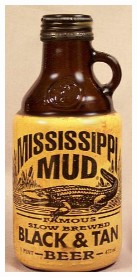 Black & Tans don’t have to come in the form of Guinness and Harp or Bass, in fact many are already premixed. Mississippi Mud, produced in Utica, NY is an all-American black and tan that doesn’t require special bartender teaspoons, or even a glass to be enjoyed. It’s certainly not the best B&T I’ve ever had, but it’s hard to resist drinking out of that widemouth “white lightning” jug. For a Midwestern example, try Gray’s Black & Tan, from Janesville, Wisconsin, another example of a premixed.
If you’ve never experience the flavor and sight of a black and tan, I suggest you order one the next time you find yourself in an Irish pub. The visual effect alone is enough to justify the purchase.
Also, I’m putting bass.com as one of the websites below, but navigate at your own peril. It made me feel like I’d had a few B&Ts when I went there.
Links of Interest:
Guinness
Bass
http://www.irish-society.org/Hedgemaster%20Archives/black-tans.htm
Monday, October 15, 2007
Now that's a Stout Porter!
It was a good weekend for beer. Amber and I went to a beerfest in Wisconsin Dells called: “Wisconsin on Tap”. The event featured 27 Wisconsin microbreweries and Goose Island, a Chicago based brewery that got in on a technicality: they have “Wisconsin distribution.” I like some of Goose Island’s beers but we did not approve of them sneaking into a Wisconsin only beerfest, and didn’t drink any of their beers in silent protest. We’ll have a full review of the event later in the week, but to prepare you for some of the highlights I’ve decided to give some background on a type of beer perhaps less common than traditional ales and lagers, at least in the United States: stout.
When I first began drinking beer, I didn’t know that porters and stouts were essentially the same thing. I knew they were both similar in taste and appearance, but in my ignorance I assumed they were produced in different ways; although there are different types of stouts/porters, they are essentially of the same family.
Porters first arose in England sometime between 1730 and 1750, depending on who you ask. While some argue that the name porter came from the dark beer’s popularity among workers who carried food and goods through London, others dispute the authenticity of such notions, including Michael Jackson (the legendary beer critic, not the moonwalker). In any case porters were dark beers that generally used more roasted malts.
Brewers often made several different strengths of porter and would use certain adjectives to differentiate between the styles. Stout, long used as an adjective for “strong” beer, was used to designate strong varieties of porter. In fact, Guinness, perhaps the most well known stout in the world is a variety of porter. In 1799, the Arthur Guinness brewery stopped making ale and decided to focus efforts on its porters, one of which, the Guinness Extra Superior Porter, is the precursor of today’s Guinness Original and Guinness Extra Stout. Guinness produces dry or “Irish” stouts, but there are other varieties of stouts as well: imperial or “Russian” stouts, coffee, oatmeal, chocolate, milk and Baltic.
More to come on stouts when we discuss the Wisconsin on Tap beerfest. Now, go to your local Irish watering hole and enjoy some flavor and history by chugging a few pints of the black stuff (in moderation, of course).
Link of interest:
http://www.guinness.com
http://www.beerhunter.com/documents/19133-000041.html
http://wisdells.com/WisconsinDellsAttractions/autumnharvestbrewers.cfm
Friday, October 12, 2007
Oktoberfest!
If the word “Oktoberfest” was used in a word-association test, the most common response would surely be “beer.” Many cities around the world hold an Oktoberfest celebration, including: Cincinnati, Ohio; La Crosse, Wisconsin; Milwaukee, Wisconsin; Denver, Colorado; Blumenau, Brazil; and Hong Kong, but the fest from which all these others draw their name is held annually in München, Bayern (Munich, Bavaria).
Since its inception as a celebration of the marriage of Crown Prince Ludwig (later King Ludwig I) to Princess Therese of Saxony-Hildberghausen in 1811, beer has been a central pillar in what has become a Bavarian tradition. Although beer stands long allowed fairgoers to fresco their tonsils with the Bavarian brush, the beer tents that we know and love were not added until 1896 by landlords who were backed by the local breweries.
Today Germany’s Oktoberfest draws 6 million people from all around the world to revel in Bavarian culture. The question for those of us not fortunate enough to travel to Deutschland is: what Oktoberfest beers would be good to enjoy at my local fest, or in my own home. After some exhaustive “research” we have some recommendations for you.
Aus Deutschland
Spaten Oktoberfest (Munich, Germany)
According to Spaten’s website their Oktoberfestbier is brewed each spring for “das größte Volksfest der Welt” (the largest folk festival in the world), and is 5.9% alcohol. Spaten Oktoberfest is a medium bodied amber beer, just slightly sweet with a rich malt body and just enough hops for one to notice the bitterness. In contrast with many American Oktoberfest beers, it is not spicy, nor is it too sweet or rich in body to prevent you from quaffing multiple mugs of this delicious lager (Amber & Ryan encourage you to chug responsibly).
From the US
Samuel Adams Octoberfest (Boston, MA)
Sam’s Octoberfest is an excellent American variety. It has a rich copper color, and a deep malt taste that according to their website is balanced by “German noble hops.” The beer is not as sweet as Spaten’s and the hops come through a little bit more. It has a medium body and you can definitely have more than two of these in a sitting (again, please chug in moderation).
Sprecher Oktoberfest (Glendale, WI)
Established in Brew City itself, Sprecher has since moved its operations to Milwaukee’s suburb of Glendale. Sprecher has a large roster of year-round beers and sodas (try the root beer), as well as a large selection of seasonal brews of which the Oktoberfest is one. The Oktoberfest is 5.75% alcohol, and boasts a blend of Caramel, Munich, and Pale hops. The beer is exceptionally smooth, even more so than the Spaten or the Sam Adams. The body is also slightly richer than both of the aforementioned beers, but it lacks the hops bite. Compared to other Oktoberfests of the area, Sprecher wins out, so if you’re in Milwaukee make sure you have your barkeep pull the tapper on this one a few times (Amber & Ryan suggest you take a cab, drunkie).
Stay tuned for pictures from Amber & Ryan's very own Oktoberfest!
Links of interest:
http://www.muenchen.de/Tourismus/Oktoberfest/7548/index.html
http://www.spatenbraeu.de
http://www.samueladams.com/
http://www.sprecherbrewery.com/beer.php?cat=2
