
Established in downtown Milwaukee in 1987, Water Street Brewery (WSB) was certainly at the vanguard of the brewpub movement. Housed in a turn-of-the-century brick building with large brew kettles visable behind glass walls, the brewpub exudes Milwaukee charm.
Water Street initially offered just three varieties of beer, but now WSB has a full slate, including a pale ale, a weiss, an amber ale, an Oktoberfest, a "Munich" lager, and a large rotation of seasonals, this time featuring a "Black Lager."
The Weiss did not stock up in calibre to some of the great Germans like Hacker-Pschorr or Franziskaner, but it was well made and delicious. To put it on more equal footing, I prefer it to the Great Dane Crop Circle Wheat (a brewpub in Madison).
The Black Lager, however, was delicious. Although it does use some malts that have been roasted longer, it's much more a black pilsner than a stout. It's light but definitely has texture, with a clean malty taste reminiscent of a St. Pauli Girl Dark. Definitely reccommended. The menu is extremely extensive for a brewpub and offers the full gamet of fare: from appetizers, to salads, to sandwiches, to chef specialties. The current brewmaster is George Bluvas III, but I confess I'm also interested in who the executive chef is. There were classic Milwaukee sausage options, with wares from nearby Usinger's, as well as light fare with a Yellowfin sandwich, salads, and vegitarian options.
Located near Milwaukee's Performing Arts Center (PAC), the Pabst Theatre, and the Bradley Center (home of the Milwaukee Bucks and Marquette Golden Eagles), the WSB is ideally situtated for you to try it's food and more importantly, it's beer. Visit this Milwaukee staple the next time you are in town.
Links of Interest:
Water Street Brewery
Monday, November 19, 2007
Water Street Brewery


Friday, November 16, 2007
Pabst Americana - Grain Belt
In this series we explore the vanishing regional beers of America. Our first will be Grain Belt, of Minneapolis.
1890, four breweries, John Orth, Heinrich, F.D. Norenberg and Germania, merged and began operating out of Orth's facilities, the largest of the four. 2 years later the brewers commissioned a new building to house their facilities. Four different architectural styles were incorporated in the building to signify the four former breweries, and the result was a castle like structure that to this day sits on the bank of the Mississippi in North-East Minneapolis. The city of Minneapolis bought the structure in 1987 to prevent demolition and today the site is home to the RSP Architecture firm as well as a branch of the Minneapolis public library system.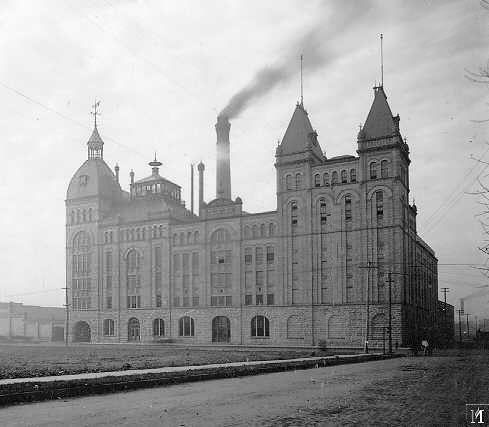
In 1893 the breweries reincorporated under the name Minneapolis Brewing Company, the same year that a new line of beer was rolled out: Grain Belt.  Grain Belt became a huge success in the Upper Mississippi River Valley, and became Minneapolis Brewing's flagship beer. Unfortunately for the fortunes of the Minneapolis Brewing company, the puritanical forces of America had seized the country and found it's whipping boy in alcohol. Prohibition stopped the production of Grain Belt, while the brewery switched to producing Near Beer (ugh, the very thought!), malt syrup, and soft drinks.In 1933, America came to its collective senses and Grain Belt was brewed once again.
After prohibition, beer drinkers preferences began to shift away from the corner bar an into the home, aided, in part, by the spread of electric refrigerators. Grain Belt introduced take home bottles (they already had returnable long-necks), as well as cone top cans that opened just like bottles. Around this time Grain Belt erected a large 40'x40' sign on Nicollet Island with a bottle cap behind its trademark red diamond logo. The sign still greets motorists driving across the Hennepin Avenue bridge just outside of downtown Minneapolis, although it is no longer lit up.
 After World War II, beer consumption at home continued to increase, as well as a preference for a smooth lager. In response Grain Belt launched the "Premium" beer, a golden lager that came in clear bottles. This is the Grain Belt that most of us are familiar with today. "Premo" was slightly more expensive, but it was a huge commercial success and became a staple for the brewery, igniting years of growth, despite its proximity to the brewing titans in St. Louis and Milwaukee. By the end of the 1960's, Grain Belt was the 18th largest brewer in the country and the company had changed its name to the Grain Belt Breweries.
  In the 1970's Bud and Miller were stepping up their advertising and marketing campaigns and regional brewers like Grain Belt were feeling the pressure. Amidst financial troubles in 1975, the shareholders agreed to sell the company, and by the end of the year the company was out of business and the once mighty brewery was closed. By 1976, both the original Grain Belt and the new Premium brand were acquired by Heileman Brewing of La Crosse, Wisconsin, and were being brewed at the cross town rival brewery, Schmidt, in St. Paul.
Under Heileman, Grain Belt took a back seat to Schmidt, and of course, Heileman's flagship, Old Style. Marketing was stepped down, packaging was downgraded, and the recipe was changed. During the 1980's, Heileman began to have it's own financial problems, and closed the Schmidt plant at the end of the decade. Fortunately, the Grain Belt brands were purchased away from Heileman and reincorporated under the Minnesota Brewing company name. By 1991, Grain Belt was once again being produced in St. Paul.
Once reinvented as Minnesota Brewing, the old Grain Belt recipes were brought back. Although the brand's reputation had taken a nose dive under the Heileman leadership, Premium's resurgence was helped along by winning Best American Lager at the Great American Beer Festival in Denver. "Premo" was jumped on by old fans and Twin Cities hipsters, but it wasn't enough to be profitable in a sea of giant macros and ever-expanding micros. The company was soon bankrupt. Again, Grain Belt received a stroke of fortune. Another local Minnesota brewer, August Schell of New Ulm, decided to purchase the Grain Belt brands. Although the original Grain Belt Golden has been phased out, Grain Belt Premium has flourished under Schell, and is to this day still available throughout the Upper Mississippi River Valley. Among the regional breweries of yore, Grain Belt is a bit of a success story: it's still around; it's still brewed in it's home state; it's still independent; and, it doesn't taste like shit. Next time you are in the Twin Cities, ask for a "beer of exceptional quality," toss back a "Premo," and taste some history.
Support your local Macro?
Today it seems you are limited to 3 choices when it comes to a cheap American style lager: Bud, Miller, or Coors, and Miller and Coors are the same company now! Regional breweries used to dot the country like the Golden Arches, but most have been bought out, disbanded, or maginalized. Some still exist be they are rare and are usually owned by a larger company.
The empires of these beloved regionals have fallen to be replaced by distant, giant beer monoliths that might as well make beer on the moon (Aside to venture capitalists: if you want in on my "Lunar Brew" now's the time to jump). These breweries may be shadows of their former selves, but they will not be forgotten, as we probe the histories of these empires in a segment I call: Pabst Americana.
Beer of the Week - Joyeux Anniversaire!

Since this week I am celebrating the anniversary of my birth, it is only right that the BOTW be a anniversary celebration of sorts as well.
We talked a little about the Canadian brewery Unibroue back here , so if you want a little of the brewery back story, go check it out.
Each year, Unibroue releases a special brew outside of its standard repertoire to commemorate the anniversary of the brewery. This is the 16th year of the brewery, and the beer has been aptly titled "16" as well.
My only criticism of this beer is that it is totally within the comfort zone of Unibroue; however, Unibroue makes excellent beers in the Belgian tradition, so this isn't entirely a bad thing.
While you can get most of Unibroue's roster in 12oz. bottles, the 16 only comes in a 750ml champagne style bottle. This brew is so delectable that you're probably going to want a whole bottle to yourself, so buy an extra bottle to share. Be advised that 16 weighs in at 10% ABV, so after you've sucked down 750ml, call a cab.
16 has an exceptional head, forming a tall, tight layer of thick bubbles to protect the brew before eventually settling to about 1/4". The beer is a cloudy burnt orange, and has a yeasty citrus aroma, backed by a honey-like malt sweetness. The initial taste is sweet, but the alcohol and the hops/yeast mix give it a balanced almost "sour apple" type back. The carbonation is penetrating and the finish is alcohol dry. Delicious!
If you don't like the Belgian yeast and noticeable alcohol, then you aren't going like this beer. If you are a more adventurous quaffer, then hoist a glass and salute 16 years of quality brews from Quebec, and Unibroue 16, our first Canadian BOTW.
Joyeux Anniversaire!
Wednesday, November 14, 2007
Beer of the Weak

After my scathing review of Granite City, you may think that I have spit enough anti-corporate vitriol this week; I haven't.
Michelob is the Anheuser-Busch (Budweiser) subsidiary famous for such delicious brews as Michelob Golden Light and Michelob Ultra (I'm guessing Martin Lel, the Kenyan who won the New York marathon, chugged a few of the later when he was done).
While browsing the selection at my local beer market, I saw something out of place. In a beat-up green six-pack near the leftover Spaten Oktoberfest, sat Michelob "Marzen," subtitled "Octoberfest."
Here is a beer that never should have been. Michelob is taking a tradition from Bavaria, one of the world's holiest beer bastions, and putting not only into the context of the world's largest brewery, but also a brewery that puts rice in its best sellers (Germany has a "law" against this, the Reinheitsgebot). Bud already has a stranglehold on the world macro market, does it need to stick its fingers into the market of beer tradition too?
I would be surprised to see this brand around much longer. To me, people who are looking for a good Oktoberfest are going to scoff at Michelob, while the rest aren't going to care about Oktoberfest anyway. Maybe there are a few post-frat yuppies out there that will bring it to the next Monday Night Football gathering or other similar bro-love fests, but I hardly expect it to expand the market that Bud already has.
For full disclosure, I'm from Milwaukee, which could explain me being so vehemently anti-Bud, but I like to think it's because their beer sucks. Now, I may write a beer blog, but I haven't forgotten my roots; I'd drink a High Life over any Bud product any day of the week. You can even throw Miller Lite on top of that last statement. I just think that Miller's beers have more character, which is something that I also look for in buying an Oktoberfest: something that Michelob Marzen is woefully short on.
Monday, November 12, 2007
The Corporate "Brewpub"

I suppose it was only a matter of time: realize that America thought brewpubs were quaint, unique, and a part of the community, and suck the soul out of it for packaging and mass consumption.
Amber & I went to the Granite City brewery this weekend in Madison. Perhaps I should say a Granite City versus the Granite City because there are similar structures in Minnesota, the Dakotas, Nebraska, Kansas, Arkansas, Illinois, Indiana, Missouri, Iowa, and Ohio. In fact this NASDAQ listed (GCFB) publicly traded company has ballooned from 1 location to 20 locations in just 8 years. In fact, their second "brewpub" opened for business less than 18 months after their first. To me that says "business plan" more than "brewery." The experience at Granite City reflects that.
The exterior of Granite City (which was in a mall parking lot) looked like a prefab sprawl-pod that just as easily could have hung up a "Tumbleweed" or "Applebee's" sign. The interior was drab and boring. This place didn't reek of brewing lore; it was closer to TGI Friday's, 10 years superficially matured.
The menu was extensive, extremely extensive, which made the following omission that much more glaring: the lack of vegetarian options. Now, I'm no vegetarian, but I do like to limit my meat intake, and there were no options for that. What if I wanted to go there with my veggie friends? Are they to have a house salad and nothing more?
The service was OK, although I felt like I was dealing with Chili's rejects. What was with all the buddy-buddy chat, and the upselling? I'm not afraid to order an appetizer, I just don't want one. Also, he knew nothing about beer, which in a brewpub is kind of a "no-no."
To the important stuff: I hate to say it, but their IPA and bock weren't bad, if unadventurous. The IPA was a clear copper with a minimal floral head, and a nice sufficient hopped finish. At 5.2%, it could stand a little more alcohol, but it was definitely drinkable. The Bock was slightly better than the IPA, but also not outstanding. It was smooth and moderately malty with an almost non-existent head. It was slightly sweet, but not overpowering. Drinkable, but middle of the road and vanilla, especially for a Mai Bock. We also sampled the "Northern Light," which was a light lager, that tasted like a Miller Lite. I was afraid it would be watery, but it wasn't; there was a little American lager flavor shining through, although there was scant carbonation and no head. To tell you the truth, you'd be better off ordering a Miller Lite.
When I first heard about Granite City, I was thinking that it was a new upstart brewery from the Minnesota city from which it takes its name (St. Cloud). But this brewpub was an idea cooked up in a board room, not a brewpot. There is obviously a lot of financing behind this chain, and you can be sure that if you live in Suburbia, Granite City is scouting mall parking lots near you. If during the holiday season, you find yourself out in the sprawl doing some shopping, I would suggest checking it out for yourself; it's a nice respite from the Olive Garden. Otherwise, don't go out of your way.
Links of Interest:
Granite City
